
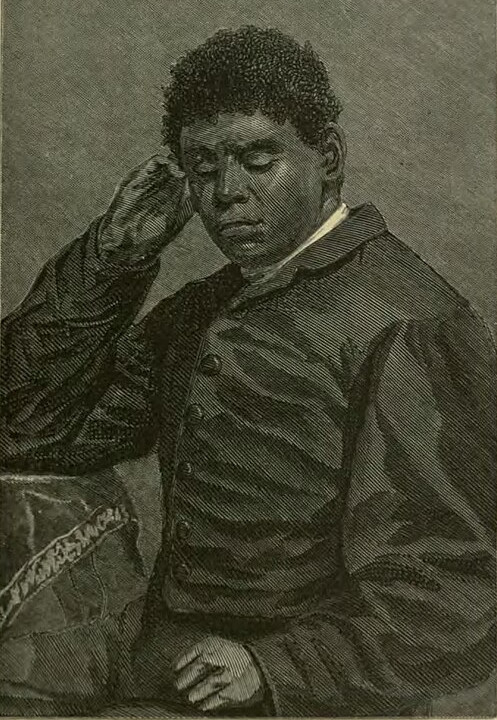

Thomas “Blind Tom” Wiggins and
Water in the Moonlight:
Genius in the Present Tense
Thomas Greene Wiggins, known as Blind Tom, was a prodigy whose genius filled concert halls but whose story is inseparable from the injustices of his era. Water in the Moonlight offers a glimpse of his quieter brilliance: shimmering textures, gentle movement, and a tender sense of hope and longing. This Portrait in Sound invites us to listen anew.
Imagine being a musical prodigy with perfect pitch and the ability to replicate complex compositions after hearing them only once… a gifted composer whose work would become recognized as foundational to American music and a precursor to modernism… a true international sensation who delighted millions… but who, legally speaking, did not own his own body.
Thomas Greene Wiggins was a nineteenth century musical prodigy born into slavery in Georgia. Blind from infancy and, by many modern interpretations, likely autistic, “Blind Tom” made history at just eleven when he became the first African American musician to perform at the White House, playing in what was described as a “command performance” for President James Buchanan.
Yet performances of that scale were not extraordinary for Blind Tom. The Bethune family, who enslaved him and his parents, built a lucrative career around his extraordinary gifts. They exploited both his musical genius and his disabilities, marketing him as a spectacle and forcing him to perform relentlessly, sometimes four times a day. Over the course of his life, they amassed profits equivalent to more than a million dollars in today’s currency, while Tom himself remained without autonomy, protection, or meaningful compensation, even after emancipation had legally made him a free man.
And yet, to focus only on the injustice of Blind Tom’s life would be to miss the astonishing scope of his genius.
Wiggins possessed a musical memory so precise that he could reproduce entire works after a single hearing, including pieces by Liszt, Thalberg, and other virtuosic composers of the era. Audiences reported that he could mimic not only the notes but the interpretive nuances, the pedaling, and even the physical gestures of the performer he had heard. He absorbed sound the way others absorb language.
But imitation was only part of his gift. He wrote constantly, pulling together the catchy charm of parlor music, the strong, singable melodies of church hymns, fragments of popular tunes, and the uniquely American rhythms and textures just beginning to take shape, creating pieces that still feel surprisingly modern today. Long before ragtime crystallized as a genre and American modernism claimed its place on the global stage, Blind Tom was experimenting with rhythm, texture, and harmonic color in ways that resist easy categorization. He was not merely a novelty; he was an innovator.
One of the most luminous examples of that innovation is Water in the Moonlight.
Unlike the showpieces that often dazzled audiences in his lifetime, this work reveals a quieter side of Blind Tom’s musical imagination. It is atmospheric, almost impressionistic, unfolding in ripples and reflections rather than grand, sweeping flourishes. The piece shimmers with a melancholy light, like bittersweet longing tempered by hope.
Listening today, it is difficult not to hear how far ahead of its time it sounds. Decades before Debussy would make water a central metaphor for tonal color and fluid harmonies, Blind Tom was already painting with similar shades of sound. The textures move with luminous s and flow, inviting immersion rather than spectacle.
Even after emancipation, the Bethunes petitioned the courts to retain legal control over him and his earnings, arguing that he was incapable of managing his own affairs. In practice, this meant that while he toured internationally and generated enormous income, he remained legally and financially dependent on the very family that had once enslaved him.
In his later years, Wiggins’ public performances grew less frequent as his health declined, and his legacy gradually slipped from mainstream recognition. When he died in 1908, the world he had astonished so completely had already begun to forget him.
There are lamentably few recordings of Blind Tom Wiggins’ compositions today, and most of his music survives only on paper. For a composer who once filled concert halls across continents, the silence is striking, and it makes every new performance matter.
Justin’s interpretation of Water in the Moonlight answers that silence with quiet intention. In the luminous textures and emotional depth of the piece, Blind Tom’s voice feels vividly present, its phrases carrying quiet drama and a tender blend of hope and loss. It reminds us that this music does not belong on the margins of history, but in the living soundscape of the present moment.
Sources and Further Reading
White House Historical Association. “Blind Piano Prodigy Thomas Greene Bethune.”
https://www.whitehousehistory.org/blind-piano-prodigy-thomas-greene-bethune
PBS American Masters. “Thomas Wiggins: Composing the Future.”
https://www.pbs.org/wnet/americanmasters/thomas-wiggins-documentary/33570/#full_length0
Zick, William J. “Thomas ‘Blind Tom’ Wiggins (1849–1908).” BlackPast.org.
https://blackpast.org/african-american-history/wiggins-thomas-blind-tom-1849-1908/
Perkins School for the Blind. “Thomas Wiggins.”
https://www.perkins.org/thomas-wiggins/