
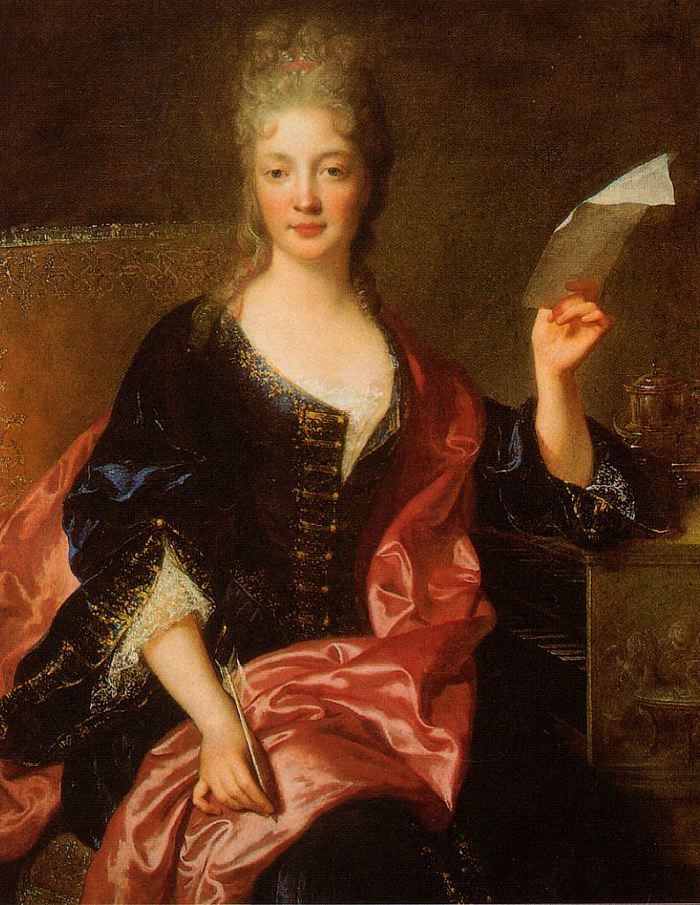

Élisabeth-Claude
Jacquet de La Guerre:
A Trailblazer of the French Baroque
In an age when women were rarely allowed public musical careers, Élisabeth Jacquet de La Guerre built a career unlike any other woman of her time, becoming one of the most celebrated composers of Louis XIV’s France.
In the glittering cultural world of seventeenth-century France, music flowed through the halls of Versailles as freely as the politics and intrigue that shaped the court of King Louis XIV. Yet amid this highly structured and male-dominated musical landscape, one figure carved out an extraordinary career: the composer and harpsichord virtuoso Élisabeth-Claude Jacquet de La Guerre.
During her lifetime she was admired as a prodigy, celebrated as a virtuoso performer, and respected as a composer who could move effortlessly between the worlds of courtly spectacle, chamber music, and dramatic vocal works. Today she is recognized as one of the most remarkable musicians of the French Baroque era and one of the earliest women in European history to sustain an independent career as a professional composer.
Born Into Music
Élisabeth Jacquet was baptized on March 17, 1665, in the parish of Saint-Louis-en-l’Île in Paris. Music surrounded her from the beginning. Her grandfather and father were master harpsichord makers, and her father, Claude Jacquet, also served as an organist at the local church. The family home was therefore not only a household but a workshop and musical training ground.
All of the Jacquet children became musicians, but Élisabeth’s gifts were apparent almost immediately. Her father oversaw her early education at the keyboard, teaching her not only technique but the professional skills needed to navigate the world of Parisian music making. This domestic education was typical for women at the time, who were largely excluded from formal musical institutions such as choir schools or academies. Even so, Élisabeth’s talent quickly surpassed the boundaries of private instruction.
The Child Who Astonished Versailles
At just five years old, the young musician was presented at the court of King Louis XIV. There she sang and played the harpsichord before the monarch, astonishing the assembled courtiers with her skill. The king reportedly took an immediate interest in the prodigy, and according to later accounts, she was affectionately referred to as “la petite merveille” (the little marvel).
Recognizing her exceptional ability, Louis XIV placed the young girl under the protection of his influential mistress, Madame de Montespan. For several years Élisabeth lived within the orbit of the royal court, receiving education and patronage that few musicians, let alone women, could hope to obtain.
Life at Versailles exposed her not only to the highest level of artistic culture but also to the complex social machinery of Louis XIV’s court. Navigating this environment would become a skill that served her throughout her career.
Marriage and a Professional Career
In 1684, at the age of nineteen, Élisabeth married the organist Marin de La Guerre, linking her already prominent musical family with another respected dynasty of Parisian church musicians. From that point forward she was known as Élisabeth Jacquet de La Guerre.
Marriage might have marked the end of a public musical life for many women of the time. Instead, Jacquet de La Guerre continued to perform, compose, and teach. She hosted concerts in her home, wrote music for court occasions, and cultivated patrons among both aristocratic and bourgeois audiences in Paris.
Her ability to move between these social worlds – royal court, professional musicians, and urban salons – became one of the defining features of her career.
A Composer in Many Genres
Jacquet de La Guerre was remarkably versatile. Over the course of her career she composed music for the stage, the church, and the chamber.
In 1687, at the age of twenty-two, she published Les pièces de clavessin, a collection of harpsichord suites dedicated to Louis XIV. Printed keyboard collections were relatively rare in seventeenth-century France, making the publication itself a significant achievement.
Her keyboard music draws on the expressive traditions of the French harpsichord school, including the distinctive style brisé, in which chords are broken into delicate, flowing patterns. She also used the evocative unmeasured prelude, a form that gives performers freedom to shape rhythm and expression.
But she was not content to remain within established forms. Jacquet de La Guerre also became one of the earliest French composers to embrace the Italian sonata, blending its energetic style with traditional French elegance. Her violin and trio sonatas helped introduce these Italian ideas to French audiences at a time when debates about musical style were intense.
The First French Woman to Write an Opera
Perhaps her most daring achievement came in 1694 with the premiere of her opera Céphale et Procris at the prestigious Académie Royale de Musique in Paris.
With this work Jacquet de La Guerre became the first French woman known to compose an opera for the national stage. The opera followed the conventions of the French tragédie lyrique established by Jean-Baptiste Lully, combining recitative, arias, dance, and orchestral interludes.
Despite its historical importance, the opera received only a short run of performances. The reasons remain uncertain. Scholars have proposed several explanations, including a weak libretto, shifting court tastes, and the waning royal enthusiasm for opera in the 1690s.
Even so, the premiere represented a milestone in French musical history.
Loss and Independence
The years that followed brought both personal tragedy and professional transformation. Around the mid-1690s Jacquet de La Guerre lost her only son, a child who had already shown promise as a musician. A decade later, in 1704, her husband died as well.
Rather than withdrawing from public life, she continued her career with renewed independence. As a widow she supported herself through composition, teaching, and the fashionable salon concerts she hosted in her Paris home. These gatherings attracted admirers who came to hear her perform and improvise at the harpsichord.
Contemporary accounts describe her ability to improvise elaborate musical fantasies for long stretches of time, captivating audiences with both technical brilliance and expressive imagination.
Cantatas and Musical Storytelling
In the early eighteenth century Jacquet de La Guerre turned increasingly toward vocal music. Between 1708 and 1711 she published two collections of Cantates françoises, dramatic works based on stories from the Old Testament.
These cantatas function almost like miniature operas, using vivid musical gestures and dramatic contrasts to depict the emotional struggles of their characters. Several focus on powerful female figures from scripture, including Judith, Susanne, and Esther
Her vocal writing is notable for its expressive use of silence, sudden harmonic shifts, and flexible rhythms that closely follow the natural cadence of the French language.
A Life of Artistic Success
Throughout her long career Jacquet de La Guerre remained closely associated with the court of Louis XIV, dedicating many of her works to the king and benefiting from his patronage.
Even in later life she maintained a reputation as one of France’s finest musicians. When she died in Paris on June 27, 1729, she left behind a comfortable estate that included multiple harpsichords and an elegantly furnished apartment suggesting a degree of financial independence rare for women composers of her era.
Shortly after her death, the writer Évrard Titon du Tillet honored her in his Parnasse François, a celebrated anthology that placed her among the greatest musicians of her era.
Rediscovery and Legacy
Despite her success during her lifetime, Jacquet de La Guerre’s music gradually faded from view in the centuries that followed. Like many women composers of earlier eras, she became a victim of historical neglect.
Interest in her work began to revive in the twentieth century, particularly through the efforts of musicologists studying the contributions of women in the history of classical music. Scholars such as Catherine Cessac produced major studies of her life and compositions, while performers and recording artists began exploring her music once again.
Today her works are increasingly performed and recorded, and she is recognized as one of the most important composers of the French Baroque.
A Composer Ahead of Her Time
Looking back, Élisabeth Jacquet de La Guerre stands out not simply because she was a woman composing in a male-dominated world, but because of the breadth and ambition of her musical achievements.
She wrote keyboard music, chamber works, cantatas, and opera. She helped introduce Italian styles into French music. She maintained a long professional career that spanned the court of Louis XIV and the evolving musical culture of early eighteenth-century Paris.
Above all, she demonstrated that artistic brilliance could flourish even within the rigid social structures of the Grand Siècle.
Her story is not merely a historical curiosity. It is a reminder that the history of music is richer and more complex than the familiar canon suggests.
Sources and Further Reading
Bernard, Claire. “Catherine Cessac, Elisabeth Jacquet de La Guerre: Une femme compositeur sous le règne de Louis XIV.” Clio. Histoire, femmes et sociétés 25 (2007): 249–290. http://journals.openedition.org/clio/5032.
Bristol Ensemble. “Elisabeth Jacquet de La Guerre.” Accessed March 5, 2026.
Cabrini, Michele. “The Composer’s Eye: Focalizing Judith in the Cantatas by Jacquet de La Guerre and Brossard.” Eighteenth-Century Music 9, no. 1 (March 2012): 9–45. https://doi.org/10.1017/S1478570611000315.
Cessac, Catherine. Elisabeth Jacquet de La Guerre: Une femme compositeur sous le règne de Louis XIV. Arles: Actes Sud, 1995.
Cessac, Catherine. “Catalogue de l’œuvre d’Élisabeth Jacquet de La Guerre (1665–1729).” Philidor: Centre de musique baroque de Versailles. December 2017. http://philidor.cmbv.fr/ark:/13681/hylh49a4fbndd4mu0s0a.
Cessac, Catherine. “Élisabeth Jacquet de La Guerre (1665–1729): Femme compositeur ou compositrice?” In La musique a-t-elle un genre?, edited by Mélanie Traversier and Alban Ramaut, 187–197. Paris: Éditions de la Sorbonne, 2019. https://books.openedition.org/psorbonne/83908.
Griffiths, Wanda R. “Brossard and the Performance of Jacquet de La Guerre’s Céphale et Procris.” Performance Practice Review 8, no. 1 (Spring 1995): 28–53. https://scholarship.claremont.edu/ppr/vol8/iss1/4.
Hickman, Pamela. “Élisabeth-Claude Jacquet de La Guerre.” Harpsichord & Fortepiano 16, no. 1 (Autumn 2011): 12–14.
Hogstad, Emily E. “Élisabeth Jacquet de La Guerre: The Greatest French Baroque Composer?” Interlude, November 14, 2025. https://interlude.hk/?p=141853.
Lallement, Nicole. “Jacquet de La Guerre (Élisabeth) (1665–1729), musicienne.” Château de Versailles Research Portal. Accessed March 5, 2026. https://www.chateauversailles-recherche-ressources.fr.
Parsons, Laurel, and Brenda Ravenscroft. “Élisabeth-Claude Jacquet de La Guerre: Sarabandes from the Suites in A Minor (1687) and D Minor (1707).” In Analytical Essays on Music by Women Composers: Secular & Sacred Music to 1900, 109–128. Oxford: Oxford University Press, 2018.
Pilcher, Ryan. “The Impact of Elisabeth-Claude Jacquet de La Guerre on Gender Roles in Music.” Florida State University.
Porter, Cecelia Hopkins. “Elisabeth-Claude Jacquet de La Guerre: Versailles and Paris in the Twilight of the Ancien Régime.” In Five Lives in Music: Women Performers, Composers, and Impresarios from the Baroque to the Present, 39–77. Urbana: University of Illinois Press, 2012.
Wikipedia contributors. “Élisabeth Jacquet de La Guerre.” Wikipedia, The Free Encyclopedia. Last modified February 11, 2026. https://en.wikipedia.org/wiki/%C3%89lisabeth_Jacquet_de_La_Guerre.