
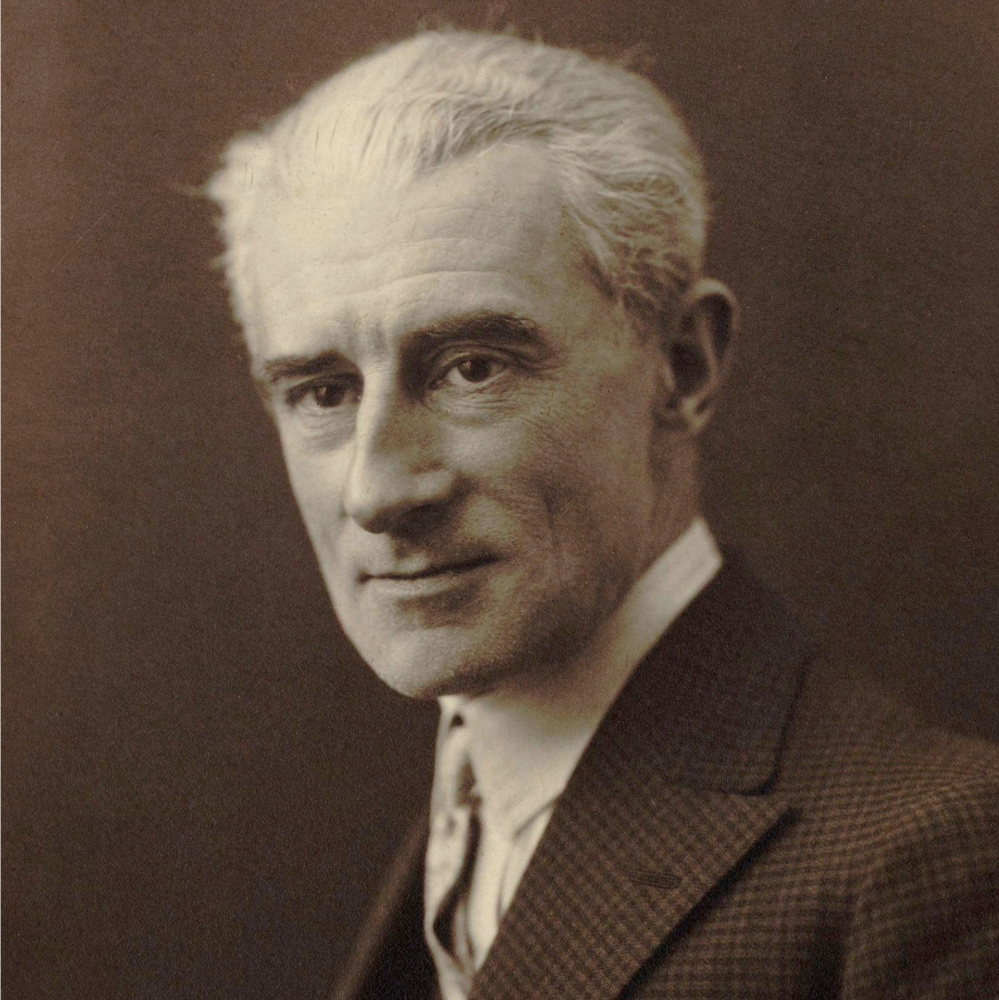

Maurice Ravel:
Duty, War, and the
Music of Memory
Maurice Ravel crafted music of jewel like clarity and extraordinary control. Yet the refined composer of Parisian salons also drove military trucks along the dark roads of Verdun, where war and memory would quietly reshape the meaning of his art.
Night on the road to Verdun, 1916. A small military truck crawls forward without headlights, its driver navigating by memory and instinct along a shattered road. The vehicle is overloaded with fuel and ammunition, its engine straining as artillery thunders somewhere beyond the darkness. One direct hit would detonate the cargo.
At the wheel sits Maurice Ravel. Wrapped in a heavy fur coat against the cold and wearing a steel helmet far too large for his slight frame, the composer guides the vehicle slowly toward the front lines. Like thousands of other drivers in the French motor transport corps, his task dangerous and unglamorous: keep the guns supplied.
It is difficult to imagine a more unlikely soldier. Only a few years earlier, Ravel had been known primarily as the meticulous creator of some of the most delicate music ever written. Igor Stravinsky once described him as “the most perfect of Swiss watchmakers.” Yet here he was, driving a supply truck through one of the most brutal battles in modern history.
The fact that Maurice Ravel was at Verdun at all was something of a minor miracle. When the First World War began in 1914, the French army had little interest in accepting him; he was nearly forty, physically slight, and already one of France’s most celebrated composers.
Ravel seemed far more at home in the refined salons of Paris than in the brutal realities of modern warfare. Yet he repeatedly attempted to enlist. His persistence reflected a conviction that the conflict exposed a moral imbalance: wars were planned by men of power and privilege, while their human cost fell largely on ordinary people. He did not believe his own status entitled him to stand apart.
To understand this obligation mattered so deeply to Ravel, it helps to understand the man he was before the war.
A composer before the war
Maurice Ravel was born in 1875 in the Basque town of Ciboure, near the Spanish border, far from the political and military centers that would later send him to war. His mother, Marie Delouart, was Basque; his father, Joseph Ravel, was a Swiss engineer and inventor, and the household reflected values of craft and precision rather than martial tradition. The family moved to Paris when Maurice was only a few months old, and the city, with its conservatories and salons, became the fixed center of his artistic life.
At the Paris Conservatoire, Ravel quickly developed a reputation for brilliance, along with a resistance to institutional authority. He clashed repeatedly with the school’s conservative traditions and never secured its most prized academic honors despite clear evidence of his talent. His repeated rejection by the Prix de Rome jury culminated in a public scandal, exposing the rigid hierarchies and political calculations that governed official recognition in the French musical establishment.
Outside the Conservatoire, however, Ravel thrived by defining success for himself. By the early twentieth century he had emerged as one of the most distinctive composers in France, his work often set alongside that of Claude Debussy. Pieces such as Jeux d’eau and Gaspard de la nuit revealed his defining traits: jewel‑like textures, technical precision, and an almost obsessive attention to detail, qualities rooted in balance, refinement, and extraordinary control.
Privately, Ravel was known for his elegance, his meticulous habits, and his deep devotion to his mother. The image he cultivated was that of a refined artist, almost a dandy, committed to craft and precision rather than overt emotional display.
War would test not only that identity, but whether such discipline and restraint could survive the demands of violence.
The war begins
When France mobilized in August 1914, Ravel was working feverishly on his Piano Trio in A minor. Knowing he might soon be called to serve, he forced himself to complete the work at a near-impossible pace. Writing to Igor Stravinsky, he described the experience with dark humor: he had finished “five months’ work in five weeks,” working with the “lucidity of a madman.” Half joking, he even referred to the trio as a “posthumous work.”
Once the piece was finished, he attempted to enlist.
The French military, however, saw little use for a composer barely over five feet tall and underweight. Ravel hoped to become an aviator, believing his small stature might suit the cramped cockpits of early aircraft. Instead, he was rejected repeatedly due to his age, weight, and a minor heart condition. For Ravel, these refusals were humiliating.
At a time when French culture equated military service with civic virtue, remaining behind the lines carried a powerful social stigma. Men who avoided the front were labeled embusqués – shirkers hiding safely from danger. Intellectuals and artists felt this pressure acutely. Even Claude Debussy expressed shame that illness prevented him from serving.
Ravel refused to accept exemption. After months of persistence, he finally succeeded.
Ravel at the front
In March 1915, Ravel was accepted into the French army’s motor transport corps as a truck driver in the 13th Artillery Regiment. It was not the role he had sought, but he accepted it without hesitation. The assignment may have seemed mundane, but it was anything but safe.
Truck drivers carried ammunition and fuel directly to the front lines, often at night and without headlights to avoid enemy fire. During the Battle of Verdun in 1916, Ravel navigated these routes himself, guiding his truck over shattered roads under constant bombardment. He affectionately named his military transport truck Adélaïde.
The conditions were brutal. Open truck cabs exposed drivers to freezing weather and shrapnel. Ravel wore a steel helmet and an enormous fur coat to survive the cold. Writing about his experience, he described traveling over “unbelievable roads with a load double what my truck should carry,” always in range of enemy guns.
Even amid the devastation of Verdun, Ravel’s sensitivity to beauty remained intact. In a brief pause between artillery barrages, he heard a small bird singing. The fragile sound struck him deeply. For a time he considered composing a piece titled La fauvette indifférente (“The indifferent warbler”), though the work was never completed.
Such moments of calm were rare. More often, the war confronted him with exhaustion, danger and, increasingly, with loss.
Loss and isolation
The human cost of the war soon pressed in on Ravel. Several close friends were killed during the conflict, including Joseph de Marliave, Jacques Charlot, and the Gaudin brothers.
But the most devastating blow came in January 1917. While Ravel was on medical leave recovering from illness and frostbite, his beloved mother died. Her death plunged him into profound despair. Friends later noted how deeply the loss marked him.
The psychological toll of the war became increasingly difficult to bear. In letters from the period, Ravel described feelings of isolation and emotional exhaustion. In one candid reflection, he admitted that he had never considered himself brave, but that he had been drawn into the war partly by a restless curiosity about experience itself.
By mid-1917, his deteriorating health forced the army to discharge him from service. He returned to civilian life physically weakened and emotionally altered.
Music after the war
Ravel’s wartime experiences left their clearest musical imprint in one of his most remarkable works: Le Tombeau de Couperin.
Completed in 1917, the suite was modeled on the elegant dance forms of the French Baroque. At first hearing, the music sounds light, graceful, even playful. Yet each movement carries a dedication, honoring a friend who died in the war.
The contrast between the suite’s cheerful surface and its tragic purpose puzzled many listeners. When critics questioned the apparent mismatch, Ravel responded with characteristic restraint: “The dead are sad enough, in their eternal silence.”
Rather than writing overtly tragic music, Ravel chose something quieter. The piece remembers individuals rather than dramatizing their deaths. In this sense, it functions less as a lament than as an act of remembrance.
For Ravel, memory itself became the monument.
The war’s quiet legacy
The years following the war revealed subtle but lasting shifts in how Ravel’s music carried meaning.
Some scholars see a decisive shift in his style. Works such as Frontispice and La Valse contain startling moments of dissonance and violence, which some interpret as reflections of wartime trauma and psychological shock.
Others argue that Ravel’s essential aesthetic remained unchanged. His fascination with historical forms, elegant surfaces, and emotional distance had already emerged before 1914. In this view, the war did not transform his musical language so much as deepen the meaning carried by it.
What is certain is that the war altered Ravel’s life profoundly. His compositional output slowed, and friends noted a persistent melancholy in his personality. Many of his later works were written for people whose lives had been shaped by the same conflict. One of the most striking examples came years later, when he composed the Piano Concerto for the Left Hand for the Austrian pianist Paul Wittgenstein, who had lost his right arm in the trenches.
The war’s presence in Ravel’s music is rarely explicit. Instead, it lingers in quieter ways: in acts of dedication, in fragments of memory, in music that remembers without mourning aloud.
Duty, war, and memory
The image of Maurice Ravel driving a supply truck through the chaos of Verdun sits uneasily beside the delicacy of the music he composed. Yet that contrast reveals something essential about him. Ravel did not respond to war by abandoning his identity as a craftsman. Instead, he allowed his craft to carry the weight of memory.
The result was music that honors loss without spectacle, grief without sentimentality. In a century scarred by violence, Ravel’s answer to war was not noise or protest. It was remembrance.
Sources and Further Reading
Blain, Terry. “What did Maurice Ravel do during World War 1?” Classical Music. July 21, 2022.
Buja, Maureen. “The Dead Are Sad Enough: Ravel’s Le tombeau de Couperin.” Interlude. May 12, 2022. https://interlude.hk/?p=109718.
Goss, Madeleine. Bolero: The Life of Maurice Ravel. New York: Tudor Publishing Company, 1940.
Haylock, Julian. “Ravel’s Daphnis et Chloé: we delve into this sensuous masterpiece and its best recordings.” Classical Music. April 8, 2022.
Hogstad, Emily E. “The Tragedy and Trauma of Ravel’s Military Service.” Interlude. January 28, 2026. https://interlude.hk/?p=144011.
Jaffé, Daniel. “French composers: the 21 greatest musicians France has produced.” Classical Music. March 30, 2025.
Kilpatrick, Emily. “Maurice Ravel and the Poetics of Originality, 1907–14.” Music & Letters. 2024.
La, Tin Vi. Maurice Ravel’s Le Tombeau de Couperin: Human emotions, grief, and the history of the Tombeau. Doctor of Musical Arts Document, James Madison University, August 11, 2023. https://commons.lib.jmu.edu/diss202029/103.
Larner, Gerald. “This composer’s personal life was an enigma. His music is a thing of wonder.” Classical Music. October 27, 2025.
“Maurice Ravel.” War Composers. Accessed March 8, 2026.
“Maurice Ravel.” Wikipedia. Last modified March 1, 2026. https://en.wikipedia.org/w/index.php?title=Maurice_Ravel&oldid=1341173433.
Mawer, Deborah, ed. The Cambridge Companion to Ravel. Cambridge: Cambridge University Press, 2000.
Parr, Freya. “17 December: Ravel and Vaughan Williams’ food-based friendship.” Classical Music. December 17, 2017.
Predota, Georg. “7 March: Maurice Ravel Was Born.” Interlude. March 7, 2022.
Quendel, Gregor. “Maurice Ravel – Biography & Compositions.” Classicals.de. 2026.
“Ravel’s ‘Le Tombeau de Couperin’.” NPR. August 21, 2008.
Rogers, Jillian Corinne. Grieving Through Music in Interwar France: Maurice Ravel and His Circle, 1914-1934. PhD diss., University of California, Los Angeles, 2014.
Walsh, Stephen. “Who Was Maurice Ravel? A Brief Introduction.” Chamber Music Society of Lincoln Center. Accessed March 8, 2026.