
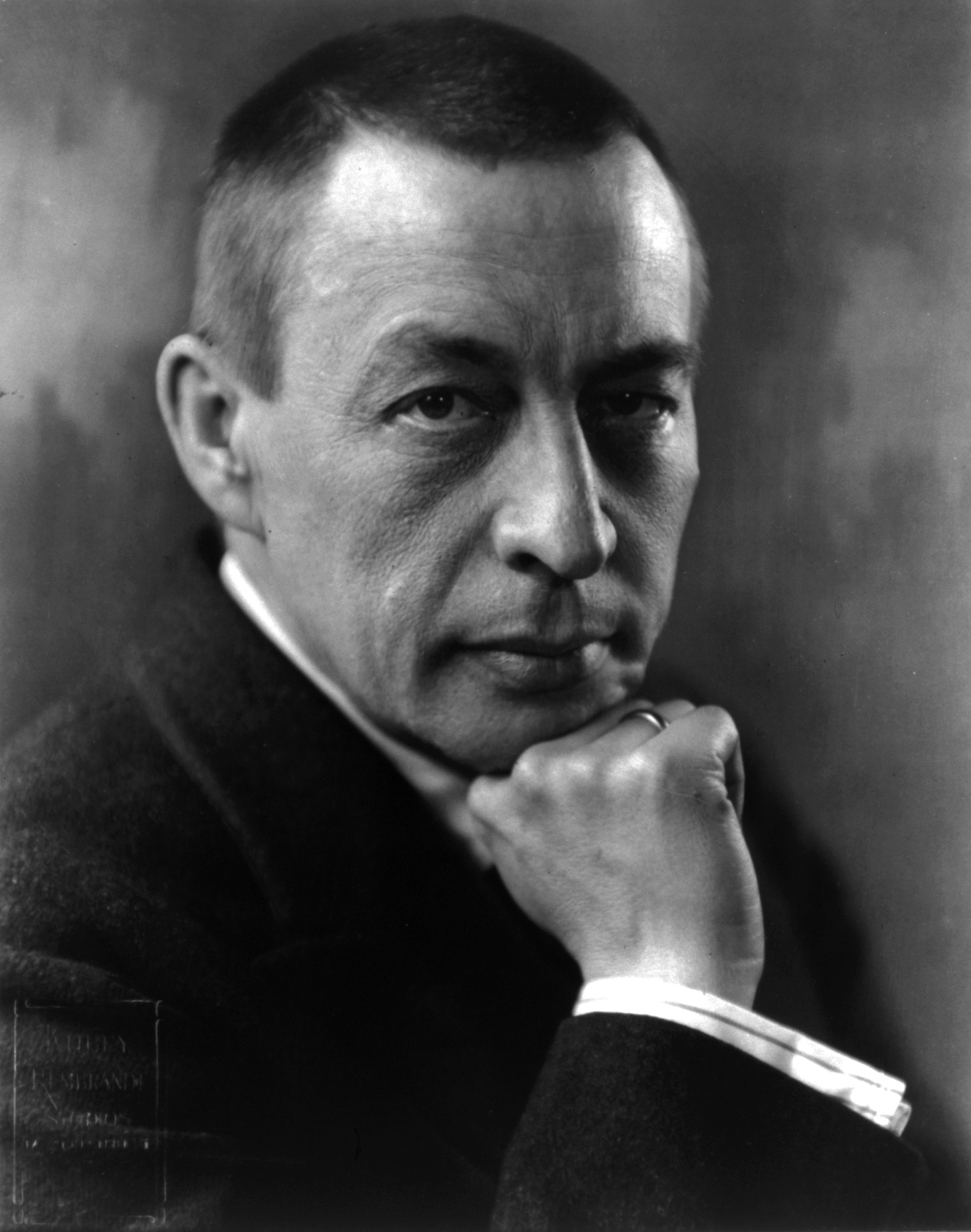

Sergei Rachmaninoff:
Cathedrals of Sound
If Chopin and Liszt were the architects of the Romantic piano, Sergei Rachmaninoff was its final skyscraper: colossal, dazzling, and impossible to ignore.
Called the “last Romantic,” he was less a relic than a living monument: a virtuoso whose music dared to be unapologetically emotional in a century that increasingly distrusted feeling. His works rise like cathedrals of sound, built on thunderous bass foundations and crowned with soaring melodic spires; they showcased the power of beauty at a time when much of the musical world was abandoning it.major phases and shifts of life and career.
Early Life, Training, and Breakthrough (1873-1897)
Rachmaninoff was born in 1873 near Novgorod, Russia into a family that once had wealth and land but was rapidly losing both. If you picture young Sergei at a piano surrounded by strict teachers, you’re not far off. His early years at the St. Petersburg Conservatory (1882-1885) didn’t exactly shine; he excelled in music but floundered in general academics, which wasn’t unusual for a kid who lived and breathed the keyboard.
The real turning point came when his cousin, Alexander Siloti, who was a student of Franz Liszt, pulled him over to the Moscow Conservatory. There, Rachmaninoff came under the stern but effective mentorship of Nikolai Zverev, a man who enforced discipline with military precision. While Rachmaninoff may not have loved the rigid schedule, it forced him into a seriousness about his craft that became the foundation of his later artistry. He also learned from big names like Sergei Taneyev and Anton Arensky, who nudged him toward composition.
By the time he graduated in 1892, he didn’t just walk away with a diploma; he earned the Conservatory’s coveted Gold Medal. Not bad for a student once written off as distracted and uneven. That same year, he wrote a little something you’ve probably heard of: the Prelude in C# minor (Op. 3, No.2). When he debuted it in 1893, the piece became an instant sensation. Audiences adored it, and for the rest of his life they begged him to play it over and over, much to his eventual frustration. Imagine writing dozens of symphonies, concertos, and choral works, only to have people should, “Play the Prelude!” like it was a rock concert encore.
With the world suddenly paying attention, Rachmaninoff decided to devote himself to a full-time career as a composer, but it got off to a tragic start. His Symphony No. 1 premiered in 1897 to devastatingly bad reviews. The backlash was brutal, and it didn’t just wound his pride; it stopped him in his tracks, throwing him into a creative silence that threatened to undo everything he had worked for.
If there were a conservatory in Hell, and if one of its talented students were to compose a programme symphony based on the story of the Ten Plagues of Egypt, and if he were to compose a symphony like Mr. Rachmaninoff’s, then he would have fulfilled his task brilliantly and would delight the inhabitants of Hell. To us this music leaves an evil impression with its broken rhythms, obscurity and vagueness of form, meaningless repetition of the same short tricks, the nasal sound of the orchestra, the strained crash of the brass, and above all its sickly perverse harmonization and quasi-melodic outlines, the complete absence of simplicity and naturalness, the complete absence of themes.
— César Cui, review of Rachmaninoff’s First Symphony
Recover and Creativity Maturity in Russia
After the crushing disaster of his First Symphony, Rachmaninoff’s life could have easily gone down a very different road. For three years he barely wrote a note, paralyzed by self-doubt and depression. It was the first major fracture in a career that, for all its brilliance, would be marked by cycles of triumph and despair.
What turned things around wasn’t more practice or a change of scenery, however; it was, surprisingly, hypnotherapy. Under the guidance of Dr. Nikolai Dahl, Rachmaninoff underwent daily sessions that helped restore his confidence and sense of purpose. Out of that healing came one of the most enduring works in the piano repertoire: the Piano Concerto No. 2 in C minor (1901). It was both a personal redemption and a huge success, instantly recognized for its sweeping melodies and emotional depth.
From that point on, his style began to mature into something distinctly his own. Musicologists like to describe it in complicated terms like “functional tonal structures,” “equal-interval chromaticism,” and “modal frameworks,” but at the heart of it, Rachmaninoff had figured out how to combine old and new in a way that sounded organic and felt timeless… as if the music had always existed. He drew on the familiar language of Western harmony (the kind you’d recognize from Beethoven or Chopin), then twisted it with unusual interval patterns and modes that gave his music a darker, more Russian color. The result was music that felt grounded but also restless, brooding, and entirely original.
One of his quirks as a composer was an obsession with the Dies Irae, a medieval chant about judgment and death. Once you start listening for it, you’ll hear it everywhere in his works, sometimes quoted directly, sometimes lurking in disguise. It first appeared in his ill-fated First Symphony, but he returned to it again and again, in The Isle of the Dead (Op. 29, 1909), in his later preludes, and in countless other places. It became his personal musical fingerprint, a reminder that even at his most romantic and lush, Rachmaninoff’s imagination was haunted by mortality.
Meanwhile, practical life forced another important change. The financial fallout from his First Symphony meant he couldn’t rely on composing alone. To support himself, he began developing a serious career as a concert pianist. At first he performed music by others, most notably Tchaikovsky’s popular B♭ minor Piano Concerto, which he played to great acclaim starting in 1911. Over time, though, audiences discovered that what they really wanted was Rachmaninoff playing Rachmaninoff, and his dual identity as both composer and virtuoso pianist was cemented at last.
By the eve of the Russian Revolution in 1917, Rachmaninoff had become one of the towering musical figures of his generation: a composer with a distinct voice, a pianist with unmatched power and nuance, and an artist who had learned, through crisis, recovery, and relentless discipline, how to turn personal struggle into lasting art.
Exile and Reorientation as a Virtuoso (1917-1943)
When the world turned upside down in 1917, so did Rachmaninoff’s life. The Russian Revolution stripped him of nearly everything: his home, his estate, his income, his sense of belonging. He left Russia with little more than a few scores and the clothes he could carry, stepping onto a westbound train as both a refugee and a reluctant exile. It wasn’t just a change of address; it was a second beginning, the kind that forces even a genius to start over.
In leaving Russia, Rachmaninoff lost the artistic ecosystem that had defined him—the Moscow Conservatory, his circle of composers and performers, the spiritual weight of his homeland. He found himself in a new world where Russian melancholy didn’t translate easily and where an artist’s survival depended not on inspiration but on income. He settled first in Scandinavia, then ultimately in the United States, joining the growing ranks of émigré artists displaced by the tides of history. The transition was jarring. Gone was the aristocratic leisure of a landowner-composer; in its place came a life on the road, a passport full of tour dates, and a constant ache for home.
Prioritizing Performance
Rachmaninoff’s shift from composer to performer wasn’t so much career pivot as it was a necessity. To keep his family afloat, he began touring relentlessly, becoming one of the most sought-after pianists of the early twentieth century. Night after night, he brought thunder and precision to concert halls across America and Europe, earning admiration for what critics called his “sovereign style… a combination of grandeur and daring.”
This transformation came at a cost: his compositional output dwindled to a trickle. Between rehearsals, travel, and the emotional drain of exile, there was little time or peace of mind to write. Yet even in scarcity, the works he did produce from this period shine with distilled mastery. Each piece feels like a monument carved with deliberation and restraint, as if he were pouring everything he had left into the music he could still make.
The Last Romantic
The musical world around him moved on to modernism. Debussy softened edges into watercolor. Schoenberg dismanted harmony altogether. Stravinsky set fire to rhythm and form. But Rachmaninoff held his ground. and built his cathedrals taller instead of tearing them down. His melodies soared, unapologetically lush, his harmonies heavy with emotional gravity.
Critics sometimes dismissed him as a relic, a sentimentalist out of step with the times. Yet the irony is that his “old-fashioned” Romanticism was itself an act of rebellion. In an era that prized dissonance and abstraction, he dared to keep writing beauty. The label “Last Romantic” fits him not because he was the final echo of a dying age, but because he carried its ideals to their furthest height and into the age of radio, records, and international tours, preserving Romanticism at a level of technical and emotional sophistication it had never reached before.
Late Works
Despite the grind of concert life, Rachmaninoff’s late compositions are anything but tired. They reveal a composer who, even in displacement, never stopped evolving. His Rhapsody on a Theme by Paganini (1934) sparkles with wit and structural brilliance, transforming a simple violin étude into a dramatic, almost narrative journey. The Third Symphony (1936) reaches back toward his Russian roots, full of modal inflections and ghostly echoes of the Orthodox chant. And Symphonic Dances (1940), his final completed work, feels like both a summation and a farewell: rhythmic, darkly jubilant, haunted once more by his beloved Dies Irae motif.
In these works, the boundaries between memory and music blur. You can hear the exile’s nostalgia, the performer’s discipline, and the composer’s enduring faith that melody still matters.
Final Years
Rachmaninoff’s final chapter unfolded beneath the California sun, an odd setting for so much Russian longing. Even as his health declined, he refused to slow down, touring until his last season in 1942–43. Just a month before his death, he was still at the piano, performing the Rhapsody on a Theme by Paganini, the same piece that had earned him a second global triumph nearly a decade earlier.
He died in Beverly Hills in March 1943, far from the birch forests and Orthodox bells that had shaped his sound. But the world he left behind continued to hear him everywhere, from concert halls to cinema scores, from recordings that never stopped spinning to students still struggling with the impossible stretches of his preludes. His story closed in exile, but his art remains forever at home in its own cathedral of sound.
Sources and Further Reading
Abbott, Eileen (2019). “All things Rachmaninoff | Alexandria Times | Alexandria, VA”. Alexandria Times.
Belaiev, Victor. “Sergei Rakhmaninov,” The Musical Quarterly 13 (1927): 359-376.
Bertensson, Sergei; Leyda, Jay; Satina, Sophia (2001) . Sergei Rachmaninoff – A Lifetime in Music. Bloomington: Indiana University Press / New York: New York University Press.
Boyd, Malcolm. “‘Dies Irae’: Some Recent Manifestations,” Music & Letters 49 (1968): 347-356.
Burkholder, J. Peter (2007). “Review of The Cambridge History of Twentieth-Century Music”. Notes. 63 (4): 844–848.
Cannata, David Butler (1999). Rachmaninoff and The Symphony. Innsbruck: Studien Verlag.
Cannata, David Butler. “Rachmaninoff’s Changing View of Symphonic Structure.” Ph.D. Dissertation, New York University, 1992.
Cannata, David Butler. “Rachmaninoff’s Concept of Genre,” Studies in Music from the University of Western Ontario 15 (1995): 59-73.
Culshaw, John. Rachmaninov, the Man and His Music. New York: Oxford University Press, 1950.
Flanagan, William. “Sergei Rachmaninoff: A Twentieth-Century Composer,” Tempo 22 (Winter 1951-1952): 4-8.
Gregory, Robin. “Dies Irae,” Music & Letters 34 (1953): 133-139.
Harrison, Max (2006). Rachmaninoff: Life, Works, Recordings. London / New York: Bloomsbury Publishing / Continuum.
Lyle, Watson (1976) . Rachmaninoff: A Biography. New York: AMS Press.
Maes, Francis (2002). A History of Russian Music: From Kamarinskaya to Babi Yar. Berkeley: University of California Press.
Martyn, Barrie (1990). Rachmaninoff: Composer, Pianist, Conductor. Aldershot: Scolar Press / Gower Pub.
Mayne, Basil (October 1936). “Conversations with Rachmaninoff”. Musical Opinion. 60: 14–15.
Moiseiwitsch, Benno. “Reminiscence of Rachmaninoff by Benno Moiseiwitsch,” Music Journal 21:1 (1963): 20.
Norris, Geoffrey (2001a). Rachmaninoff. Oxford / New York: Oxford University Press / Schirmer Books.
Norris, Geoffrey. Rachmaninov (2nd ed. 1993). The Dent Master Musicians series, ed. Stanley Sadie. London: J.M. Dent, 1976.
Rachmaninoff, Sergei. “Some Critical Moments in my Career,” The Musical Times LCCI/1047 (1930): 557-58.
Rachmaninoff, Sergei; von Riesemann, Oskar (1970) . Rachmaninoff’s Recollections, Told to Oskar Von Riesemann. New York: Macmillan Company / Freeport, NY: Books for Libraries Press.
Ramachandran, Manoj; Aronson, Jeffrey K. (2006). “The diagnosis of art: Rachmaninov’s hand span”. Journal of the Royal Society of Medicine. 99 (10): 529–530.
Rimm, Robert. The Composer-Pianists: Hamelin and the Eighth. Portland, Oregon: Amadeus Press, 2002.
Rubin, David. “Transformations of the Dies Irae in Rachmaninov’s second Symphony,” The Music Review XXIII/2 (1962): 132-136.
Sabaneeff, Leonid Leonidovich. Modern Russian Composers. New York: International Publishers, 1927.
Salzman, Eric. “Rachmaninoff DA Rachmaninoff NYET,” Stereo Review 30:5 (May 1973): 66-69.
Satina, Sophia Alexandrova. “Communication to the Editor,” Journal of the American Musicological Society XXI/1 (1968): 120-21.
Schachter, Carl. “Motive and Text in Four Schubert Songs,” in Aspects of Schenkerian Analysis, ed. David Beach. New Haven: Yale University Press, 1983.
Schonberg, Harold C. (1987). The Great Pianists (2nd ed.). New York: Simon & Schuster.
Schonberg, Harold C. (1988). The Virtuosi: Classical Music’s Great Performers From Paganini to Pavarotti. New York: Vintage Books.
Schonberg, Harold C. (1997). The Lives of the Great Composers (3rd ed.). New York: W. W. Norton.
Scott, Michael (2011) . Rachmaninoff. Cheltenham / Stroud: The History Press.
Sear, H.G. “The Influence of Paganini,” The Music Review 4 (1943): 98-111.
Seroff, Victor Ilyitch (1970) . Rachmaninoff: A Biography. London: Cassel & Company LDT / New York: Simon & Schuster.
Siloti, Alexander Ilytch. “My Memories of Liszt,” Remembering Franz Liszt. New York: Limelight Editions, 1986.
Swan, Alfred Julious, and Katherine Swan. “Rachmaninoff- Personal Reminiscences,” The Musical Quarterly XXX/1&2 (1944): 1-19 and 174-91.
Vodarsky-Shiraeff, Alexandria. Russian Composers and Musicians. New York: The H.W. Wilson Company, 1940.
Walker, Robert. Rachmaninoff: His Life and Times. Neptune City, N.J.: Paganiniana, 1981.
Wehrmeyer, Andreas (2004). Rakhmaninov. London: Haus Publishing.
Young, D. A. B. (1986). “Rachmaninov and Marfan’s syndrome”. British Medical Journal. 293 (6562): 1624–1626.