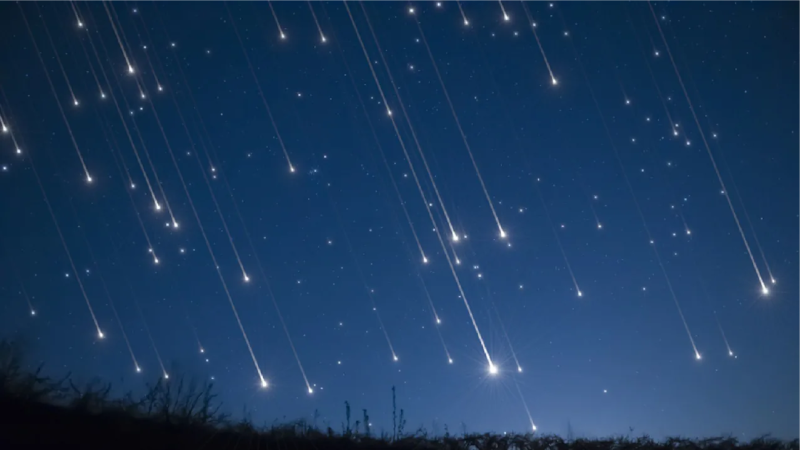
The Perseids will probably always be my favorite meteor shower.
Part of that is timing. They arrive in August, when the nights are still warm and summer has begun to feel slightly worn around the edges. Part of it is spectacle. The Perseids can be bright, generous, and easy to love. But mostly, for me, it’s memory.
The Perseids were the first meteor shower I ever saw with real clarity from my own home. I was living in a rural part of central Virginia, where the night sky had enough darkness to feel like a place rather than a backdrop. I remember standing outside and watching meteors cut across the sky with that strange mix of surprise and inevitability that only meteor showers seem to have. You know they are coming. You are waiting for them. And still, every streak feels like a tiny ambush.
But the Perseids aren’t the only summer meteors worth loving.
The Delta Aquariids are quieter. Less famous. Less reliable if you are watching amidst city lights or in northern latitudes. They don’t usually arrive with the same “clear your calendar and go outside immediately” energy as the Perseids. They are more subtle than that.
And maybe that is why I like them.
A southern shower, seen from the north
When people talk about the Delta Aquariids, they usually mean the Southern Deslt Aquariids, a meteor shower active from mid-July into late August. Their radiant – the point in the sky from which the meteors appear to stream – lies in the constellation Aquarius, near the star Delta Aquarii.
That radiant matters. Meteor showers are not actually coning from the constellation they are named for. The stars of Aquarius are vastly farther away than any meteor. The name is a matter of perspective: from Earth, the meteors appear to fan outward from that part of the sky, the way train tracks appear to meet at a point on the horizon.
For observers in the Southern Hemisphere, Aquarius rises higher in the sky, giving the Delta Aquariids a better stage. From northern places like Maryland, the radiant stays lower in the southern sky. That means fewer meteors are visible, and those that do appear have to fight through more atmosphere, haze, moonlight, and, in my case, the heroic glow of Baltimore being Baltimore.
So, no, this is probably not the easiest shower for me to see from here. But “harder to see” is not the same thing as “not worth knowing.”
The shower before the show
The Delta Aquariids arrive in that interesting stretch of summer just hefore the Perseids take over the public imagination. They overlap with the early Perseids, which means a meteor seen in late July or early August might not be a Perseid at all.
This is one of the sneaky pleasures of meteor watching. The sky does not label things for us. It does not put little captions under the meteors saying, “Hello, I am from the Perseid stream,” or, “Actually, I am a Delta Aquariids, thankyouverymuch.”
To tell the difference, observers trac the meteor’s path backward. If it seems to point toward Perseus, it may be a Perseid. If it traces back toward Aquarius, it may belong to the Delta Aquarids.
This is also a useful reminder that meteor showers are not single-night events, even though we often talk about them that way. A “peak” is just the period when Earth is expected to pass through the densest part of a stream of debris. The shower itself can be spread across weeks.
The Delta Aquariids are especially good at this slow-burn approach. They do not usually explode onto the scene. They accumulate. They linger. They blend into the background of summer nights.
They are less like a parade and more like a recurring thought.
Crumbs from a sun-scorched wanderer
The suspected parent of the Southern Delta Aquariids is Comet 96P/Machholz, which is already enough to make this shower more interesting.
Comets are often described as dirty snowballs or icy rubble piles, but that description can make them sound almost gentle. 96P/Machholz is not gently drifting around in some distant, polite orbit. It comes unusually close to the Sun, diving well inside the orbit of Mercury before swinging back out again.
That matters because meteor showers are made from debris. As comets travel through the inner solar system, they shed dust and fragments. Over time, those fragments spread out along the comet’s orbit. When Earth scrosses that stream, bits of cosmic debris slam into our atmosphere and burn. That burn is what we see as a meteor.
So when you watch a Delta Aquariid, you are not seeing a star fall. You are seeing a tiny piece of solar-system history meet its spectacular end in the upper atmosphere. A grain, a fleck, a fragment of something older than human memory flares into visibility for a fraction of a second and is gone.
There is something deeply unfair about that, but also kind of perfect.
Not all meteor dust is created equal
One of the more fascinating things about the Delta Aquariids is that their meteoroids may not be as simple as “loose comet dust.”
Recent research using observations from the Canadian Automated Meteor Observatory suggests that Southern Delta Aquariid meteoroids may have a mixed structure: compact grains embedded in a more porous, lower-density material. In other words, they may be part sturdy, part fragile.
That could help explain how they behave as they burn. A meteor is not just a streak of light; it’s a physical object being destroyed by speed, friction, pressure, and heat. The structure of that object affects how it brightens, fragments, and fades.
This is where meteor showers become more than pretty sky events. They are field tests. Every meteor is a tiny experiment conducted at absurd speed in the atmosphere, and the result is a line of light.
A Delta Aquariid meteor may be faint. It may be easy to miss. But for the few seconds it exists as something visible, it is telling us about the body that shed it, the orbit that carried it, and the strange violence of entering a planet’s atmosphere at tens of thousands of miles per hour.
Why trails matter
The Delta Aquariids are not usually famous for dramatic fireballs. They are often faint, and under bright moonlight or city skies, many of them disappear before we ever have a chance to notice them.
But under good conditions, they can produce graceful, showy streaks — the kind that seem to slide across the sky rather than simply flash and vanish. That is part of what I remember loving about them. They felt less like sparks and more like traces.
Meteor trails are one of the most emotionally satisfying parts of skywatching. A bright meteor is exciting, of course, but a lingering trail gives the eye something to follow. It briefly draws a line between motion and memory. There, then not there. Gone, but not instantly forgotten.
That makes the Delta Aquariids a slightly different kind of shower from the Perseids. The Perseids are crowd-pleasers. They are the ones you invite people over for. The Delta Aquariids are more private. They ask for darker skies, more patience, and a willingness to appreciate the faint thing at the edge of attention.
About 2026: the Moon is not helping
In 2026, the Delta Aquariids are expected to peak around July 30. Unfortunately, the Moon will be nearly full around that time, which means many of the shower’s fainter meteors will be washed out.
This is especially true from a place like Baltimore, where light pollution is already part of the observing equation. Add summer haze, a low southern radiant, and a bright Moon, and the Delta Aquariids become less “meteor show” and more “advanced-level sky patience.”
Still, the official peak is not the only possible time to look. Because the shower is active for weeks, it can be worth trying on surrounding nights, especially during the dark hours before dawn when the radiant is higher. The best viewing will always be from somewhere dark, open, and away from direct lights. No telescope is needed. In fact, a telescope would be the wrong tool entirely.
Meteor watching is gloriously low-tech. You need your eyes, a dark sky, a comfortable place to sit or lie down, and enough time for your night vision to adjust.
And snacks. This is not official astronomical guidance, but I stand by it.
How to watch, if you want to try
If you are watching from the Northern Hemisphere, look generally toward the southern sky after midnight, but do not stare directly at Aquarius. Meteors can appear anywhere in the sky, and the longer trails are often seen some distance away from the radiant.
Give yourself at least twenty to thirty minutes for your eyes to adjust. Avoid looking at your phone unless you enjoy resetting your night vision like a tiny glowing goblin. Find the darkest patch of sky you can, block nearby lights if possible, and let your gaze soften.
Meteor watching is not the same as looking for something. It is more like making yourself available. That may be one reason I love it, when most of modern life rewards directness. Search, click, scroll, refresh, optimize. Meteor showers do not care. They happen on their own terms. They ignore your schedule. They often make you wait. Sometimes they give you nothing. Sometimes they give you one perfect streak at the exact moment your mind has wandered.
The Delta Aquariids are very much that kind of shower.
The quiet ones count, too
The Perseids will probably always have my heart. They were my first clear meteor shower, and you do not forget the first time the sky feels alive above your own yard.
But the Delta Aquariids have their own appeal. They are subtler, more southerly, more elusive. They belong to the heavy, humid, waiting part of summer, when the brightest thing in the sky is not always the thing most worth noticing.
They are not the easiest meteor shower to see from Baltimore. In 2026, they may be especially difficult. But I still like knowing they are there: faint bits of cometary debris crossing Earth’s path, burning themselves into brief lines of light above a planet full of people mostly looking down.
The Delta Aquariids are not the shower that demands your attention. They are the shower that rewards it.