
Will it turn blue?
Almost certainly not.
Will that stop us from enjoying the name, the rarity, the folklore, and the chance to look up at the sky and feel briefly less annoyed by email, dishes, and whatever nonsense the world is doing today?
Absolutely not.
The full moon on May 31, 2026 is a Blue Moon because it is the second full moon in a single calendar month. May already gave us one full moon on May 1, and now it is sneaking in another one right at the end, like a lunar encore.
What Is a Blue Moon?
A Blue Moon is usually defined in one of two ways. The most familiar modern definition is the second full moon in a calendar month. That is the kind of Blue Moon we are getting on May 31.
There is also an older seasonal definition. In that version, a Blue Moon is the third full moon in an astronomical season that has four full moons instead of the usual three.
Either way, the idea is the same: a Blue Moon is an extra full moon. It is a calendar oddity, not a difference in the Moon itself.
The Moon is not doing a costume change. It is not putting on a little sapphire cape. It is simply showing up as full twice within the same named month, because lunar cycles and human calendars do not fit together neatly. The Moon takes about 29.5 days to go from full to full again, while most calendar months are 30 or 31 days long. Every so often, the timing lines up just right.
Or wrong, depending on whether you are the person trying to maintain a calendar.
Why Is It Called a Blue Moon?
The phrase “once in a blue moon” has long been used to mean something rare. The exact history is messy, as language history usually is because humans are deeply committed to making things weird and then forgetting why.
In most cases, a Blue Moon has nothing to do with the Moon’s color. It is about rarity.
That said, the Moon can sometimes appear bluish under unusual atmospheric conditions. Large volcanic eruptions or massive wildfires can send particles into the air that scatter light in such a way that the Moon appears blue or bluish. But that is not what is happening with this full moon.
So tomorrow’s Blue Moon will probably look like a regular full moon: bright, pale, beautiful, and a little smug.
This One Is Also a Micromoon
As if “Blue Moon” were not enough, this full moon is also a Micromoon.
A Micromoon happens when a full moon occurs near apogee, the point in the Moon’s elliptical orbit when it is farthest from Earth. Because it is farther away, the Moon can appear slightly smaller and dimmer than an average full moon.
Do not expect a dramatic difference. This is not the Moon shrinking like a frightened cartoon character. To the naked eye, it will mostly look like a full moon doing full moon things.
But technically, tomorrow’s full moon is a Blue Micromoon, which sounds like either an astronomical event or a very fancy cocktail.
When Should You Look?
The exact moment of full moon occurs early on Sunday, May 31, at about 4:45 AM Eastern Time.
But full moons are generous. You do not have to be standing outside at the exact minute of peak illumination to enjoy it. The Moon will look full the night before and the night after, so Saturday night into Sunday morning should be a lovely time to look.
For the most dramatic view, watch near moonrise or moonset, when the Moon is close to the horizon. That is when it often appears largest to our eyes, thanks to the Moon illusion. It is not actually bigger then, but our brains are easily impressed by scenery. Honestly, same.
Is There Any Astrological Meaning?
Astronomically, a Blue Moon is a calendar event. It is not caused by anything mystical. It does not happen because the Moon has entered a special secret mode.
Astrologically and symbolically, though, an extra full moon can feel like an extra point of illumination. Full moons are often associated with culmination, reflection, emotional clarity, and release. A Blue Moon adds the feeling of rarity, repetition, and second chances.
This particular full moon can be treated as an invitation to ask:
- What is coming around again?
- What did I miss earlier this month?
- What deserves a second look?
- What am I ready to understand more clearly now?
You do not have to believe the Moon is personally managing your inbox to find value in lunar symbolism. Sometimes a sky event is simply a good excuse to pause, look up, and organize the cluttered attic of the soul.
A Few Blue Moon Ideas
If you want to mark the occasion, keep it simple. Step outside and look at the Moon. Make a cup of tea. Write down one thing you are ready to release. Write down one thing that deserves another chance.
Look at what has changed since the first full moon of the month. Look at what has not changed, despite your best efforts, and consider whether it is still worth carrying.
Or do nothing at all except notice the sky. That counts, too.
The Takeaway
Tomorrow’s Blue Moon is not blue, not magical in a literal sense, and not likely to shake the heavens.
But it is rare. It is beautiful. It is part of the complicated dance between the Moon’s rhythm and our human-made calendars.
And every once in a while, the sky gives us a bonus full moon.
That seems worth stepping outside for.
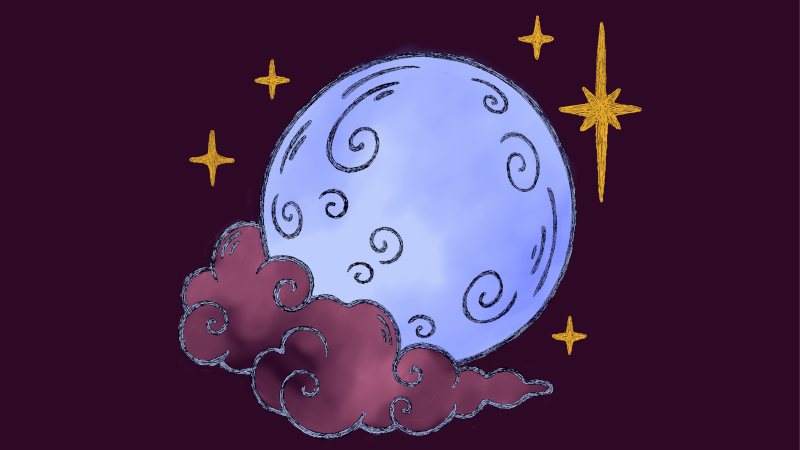
Featured image: Original artwork © 2026 by Sunny Simmons.
Leave a Reply