

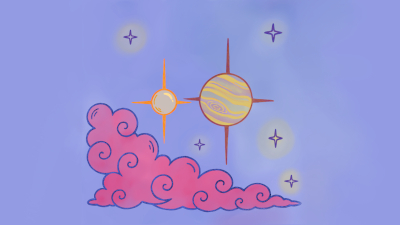
No telescope required. No fancy equipment. No astronomy degree. No need to pretend you know where Gemini is while secretly waiting for someone else to point. Just go outside after sunset, look toward the western horizon, and watch for two bright points of light sitting close together in the twilight.
That is the good stuff.
What is happening?
Venus and Jupiter will appear within about a degree or two of each other in the sky. To the eye, that means they will look close enough to feel like they are having a private little planetary meeting.
They are not actually near each other in space, of course. Space remains rude and enormous.
Venus is one of our closest planetary neighbors. Jupiter is much farther away, lumbering around the solar system like an overachieving gas giant with a moon collection problem. But from our point of view here on Earth, their paths line up just right, making them appear close together against the background of the sky.
That apparent closeness is called a conjunction.
It is not a collision. It is not an omen of doom. It is not the solar system making a suspicious grinding noise.
It is perspective. Beautiful, temporary, sky-sized perspective.
Why this one is worth looking for
Venus and Jupiter are showoffs, in the best possible way.
Venus is usually the brightest planet we can see from Earth. Depending on when it appears, people call it the Morning Star or Evening Star, even though it is not a star and has never once asked our permission to be confusing.
Jupiter is also extremely bright, especially compared with most other planets visible to the naked eye. When Venus and Jupiter appear close together, the result can be surprisingly dramatic: two brilliant lights near the horizon, close enough that even casual skywatchers may stop and wonder what they are seeing.
This is one of those events where you do not need to sell the sky too hard. It does the marketing department’s job all by itself.
When and where to look
Look toward the west or west-northwest shortly after sunset on June 9.
The exact view will depend on your location, weather, and how clear your horizon is. Since the planets will be low in the sky after sunset, you will want a spot with an open view toward the western horizon. Trees, buildings, hills, and general human clutter may get in the way.
If you are in a city, do not despair. Venus and Jupiter are bright enough that you may still be able to see them through some light pollution, especially if your western sky is clear.
For best results, try this: Go outside shortly after sunset. Face west. Look low in the sky for two very bright points of light close together. Feel briefly superior to everyone indoors staring at a rectangle.
That is it. That is the observing plan.
Do you need binoculars?
No, but they could be fun.
The conjunction should be visible to the naked eye, which is part of what makes it so accessible. But if you have binoculars, they may give you a lovely view of both planets together in the same field.
A telescope is not necessary, and honestly, for conjunctions like this, it can sometimes be the wrong tool for the overall experience. Telescopes narrow your view. The beauty of a conjunction is often in seeing the planets together in the wider sky, with the horizon, twilight, and evening atmosphere all doing their little theatrical backdrop work.
Binoculars are the sweet spot if you want a little extra sparkle without turning the whole evening into equipment management.
What is a planetary conjunction, anyway?
A conjunction happens when two celestial objects appear close together in the sky from our viewpoint on Earth.
The key phrase there is “from our viewpoint.”
The planets are still moving along their own separate orbits, at their own distances, doing their own deeply committed orbital nonsense. They only look close together because Earth, Venus, Jupiter, and our line of sight happen to line up in a particular way.
This is one of those moments when astronomy reminds us that the sky is not a flat dome of pretty lights, even though that is very much how our eyes experience it. The sky is a three-dimensional mess, projected onto our two-dimensional view.
Our brains look up and say, “Ah yes, two lights next to each other.” The solar system replies, “Sure, if you ignore several hundred million miles.”
Symbols in the sky
Astronomically, this is an apparent close approach between Venus and Jupiter.
Symbolically, it is very easy to see why people have made a big deal out of these two planets for thousands of years.
Venus has long been associated with beauty, desire, pleasure, attraction, harmony, and the bright pull of the things we love.
Jupiter has been associated with growth, abundance, wisdom, kingship, luck, protection, and expansion.
So when Venus and Jupiter appear together, it is not surprising that astrologers and sky-watchers have often treated the pairing as especially lovely. The two brightest planets meeting in the evening sky? Come on. Even a dedicated skeptic has to admit that the visuals are doing some emotional heavy lifting.
Do you need to believe that this means the universe is about to personally deliver abundance, romance, and perfectly timed snacks? No.
Should you maybe take a minute to enjoy the fact that the two brightest planets are visibly sharing the same patch of twilight? Yes. Absolutely. We are not made of stone.
A simple way to mark it
You do not have to turn this into a ritual. You can just look. That counts. But if you want to give the moment a little meaning, try this:
Step outside after sunset. Find Venus and Jupiter. Notice which one catches your eye first. Think about one thing in your life that feels beautiful, pleasurable, or worth cherishing. Think about one thing you want to let grow. Then stand there for a minute and let the sky be bigger than your to-do list. No candles required. No declarations. No tiny planetary paperwork. Just a little attention.
The takeaway
On June 9, Venus and Jupiter will appear close together in the western sky after sunset, creating an easy, bright, naked-eye conjunction.
It is a simple sky event, which is part of its charm. You do not need anything special to see it. You just need a clear western horizon, decent weather, and a willingness to step outside for a few minutes.
The planets are not actually close together. But from here, for a little while, they will look like they are. And sometimes “from here” is the whole point.
Featured image: Original artwork © 2026 by Sunny Simmons.
Leave a Reply