

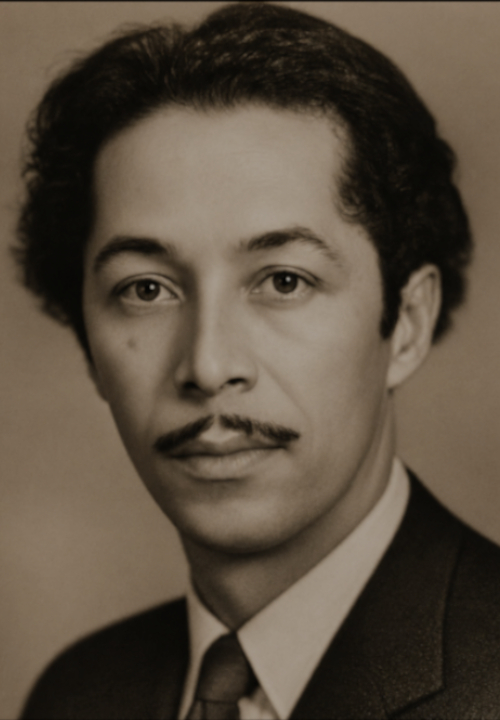
Every so often, Justin starts working on a piece by a composer I’ve never heard of, and I find myself tumbling down a research rabbit hole. That’s how I met Adolfo Mejía Navarro.
This time, the piece was Preludio: Luminosidad de las Aguas (“Prelude: Luminosity of the Waters”), a shimmering piano work by a Colombian composer whose name was completely unfamiliar to me. The more I listened, the more curious I became. The piece was beautiful; it’s atmospheric and colorful, with a sense of place that feels both vivid and difficult to pin down. More importantly, it left me wondering something that has become a recurring theme in this series: how had I never heard of this composer before?
As it turns out, I wasn’t alone. Outside of Colombia and parts of Latin America, Adolfo Mejía Navarro remains largely unknown, despite studying in Paris, writing orchestral and chamber works, composing a substantial body of piano music, and helping bring Colombian musical traditions into the classical concert hall.
The deeper I dug, the stranger that seemed, because Mejía wasn’t merely a talented composer who happened to be overlooked. He was a composer with a voice all his own, one shaped by the streets of Cartagena, the rhythms of Colombia, the sound of the guitar, and a lifelong curiosity about the wider world.
I can’t help feeling that more people should know his name.
A Composer Shaped by Place
That connection to Cartagena comes up again and again when people write about Mejía, and for good reason.
Although he would eventually study in Paris, travel internationally, and work with some of the most influential musicians of his era, the foundations of his musical voice were laid much closer to home. Born in 1905 and raised amid the rich cultural traditions of Colombia’s Caribbean coast, Mejía grew up surrounded by a remarkable blend of influences: Indigenous traditions, Spanish melodies, African rhythms, folk dances, popular songs, and the everyday sounds of a bustling port city.
For all of his travels, he never really left those influences behind. They followed him into his piano music, his chamber works, his songs, and eventually his orchestral compositions. Even as his musical language expanded, Cartagena remained part of the conversation.
And if there is a key to understanding Adolfo Mejía Navarro, it may be this: before he was a composer of concert music, he was a listener.
Cartagena sits on Colombia’s Caribbean coast, a place where cultures, languages, rhythms, and traditions have met for centuries. Indigenous influences, African influences, and European influences all left their mark on the city and the music that grew there. And long before he became a composer, Mejía absorbed those sounds as part of daily life.
His father played the tiple, a traditional Colombian stringed instrument related to the guitar, and young Adolfo quickly developed a talent for music himself. A local priest reportedly nicknamed him “Pequeño Sarasate” after the famous Spanish violin virtuoso, impressed by the boy’s musical abilities.
Before there was a piano or an orchestra, or a life in Paris, though, Mejía was just a kid with a guitar. That detail feels important because it helps explain something about his music. Even when he later embraced classical forms, he never lost touch with the musical traditions that surrounded him growing up.
Following the Music
One of the easiest ways to understand Mejía’s artistic journey is to follow the instruments.
The guitar connected him to the music of everyday life through the songs, dances, and social gatherings of Colombia’s Caribbean coast. The piano, on the other hand, became his laboratory.
In works such as Candita, Pincho, and Luminosidad de Aguas (“Luminosity of Waters”), listeners can hear a composer experimenting with color, atmosphere, and rhythm. Some pieces feel intimate and reflective. Others dance. Many carry traces of Colombian musical traditions such as the pasillo and bambuco while still speaking the language of classical music.
Luminosidad de Aguas is an especially evocative example. Originally written for the celebrated harpist Nicanor Zabaleta and later adapted for piano, the piece seems to shimmer with light. Even without knowing its title, many listeners might find themselves imagining sunlight dancing across water.
Then came the orchestra.
If the piano allowed Mejía to explore ideas, the orchestra gave him a much larger canvas on which to paint them.
His Pequeña Suite made history as the first symphonic work to incorporate the traditional Colombian cumbia, bringing a dance form deeply rooted in the country’s Caribbean coast into the concert hall.
Today that may not sound revolutionary. In the 1930s, however, it was a bold statement about what classical music could be and whose stories it could tell.
Cartagena Meets Paris
Like many ambitious young musicians of his generation, Mejía eventually traveled abroad. He lived in New York. He toured internationally. And most significantly, he studied in Paris under the legendary pedagogue Nadia Boulanger, whose students would go on to shape twentieth-century music around the world.
Paris exposed Mejía to new ideas and influences. Listeners familiar with French composers such as Debussy and Ravel may hear echoes of impressionism in some of his piano writing: colorful harmonies, atmospheric textures, and an emphasis on mood and imagery.
But what’s most remarkable is not what he borrowed. It’s what he kept. Even after studying in one of Europe’s great cultural capitals, Mejía never stopped sounding like himself.
His music never feels as though Colombian elements were pasted onto European forms as an afterthought. Instead, the two traditions seem to grow naturally from the same roots.
The result is music that feels both familiar and fresh: sophisticated without being intimidating, colorful without becoming flashy, and deeply connected to a particular place without requiring listeners to know anything about that place beforehand.
The Bohemian of Cartagena
The more I learned about Mejía, the more he seemed like the kind of person who would have been fascinating to spend an evening with.
Accounts describe him as endlessly curious, widely read, and fluent in multiple languages. He reportedly spoke Arabic, Greek, German, French, Italian, and English. Friends remembered him wandering Cartagena’s streets in a white suit, guitar in hand, ready to discuss philosophy, literature, politics, or music until the early hours of the morning.
He was not merely a composer. He was one of those larger-than-life cultural figures who seem to absorb everything around them and somehow transform it into art.
Many of his pieces were inspired by friends, gatherings, conversations, and the people who populated his world. In that sense, his music feels almost like a diary—one written not with words but with melodies, harmonies, and rhythms.
Why Have So Few People Heard of Him?
This is where the story becomes a little frustrating. The question isn’t whether Mejía was talented. The question is why his music remained so difficult to discover for so long.
Part of the answer comes down to timing. In 1939, as Mejía was thriving in Paris, World War II erupted across Europe. Like countless artists whose careers were disrupted by the conflict, he was forced to leave.
Part of it was personality. By most accounts, Mejía was far more interested in making music than promoting himself. He often failed to organize his manuscripts, sometimes gave scores away, and showed little interest in building the sort of carefully managed legacy that helps composers remain visible after their deaths.
As a result, many of his works spent decades scattered among archives, libraries, and private collections. For years, discovering his music required the persistence of scholars, performers, and researchers willing to track down fragile handwritten manuscripts and bring them back into circulation.
A Hidden Treasure Worth Rediscovering
Fortunately, that work is finally paying off. Recent editions, recordings, and research projects have made Mejía’s music more accessible than ever before. Listeners curious about Latin American classical music now have opportunities to explore a body of work that was largely unavailable to previous generations.
And what they’ll discover is not merely a historical curiosity. They’ll discover a composer with a distinctive voice: one who carried the sounds of Colombia into the concert hall without sacrificing their character. Who moved comfortably between guitar, piano, and orchestra. Who studied in Paris but never forgot Cartagena.
The history of classical music is much larger than the handful of names most of us learn first. Beyond the familiar landmarks lies an enormous landscape filled with overlooked voices, forgotten stories, and remarkable music waiting to be heard. Adolfo Mejía Navarro reminds us that sometimes the most rewarding discoveries happen when we wander off the well-traveled path. And if you’re willing to take that detour, Colombia’s Caribbean coast has a treasure waiting for you.
Sources and Further Reading
Adolfo Mejía Navarro Official Site. https://www.adolfomejianavarro.com/adolfomejianavarro-english
“Adolfo Mejía Navarro.” Sincé Sucre Colombia Blog, March 13, 2012. https://since-sucre-colombia.blogspot.com/2012/03/adolfo-mejia-navarro.html
Angulo Julio, Alvaro Jose. Colombian Composer Adolfo Mejía, Four Works for Small Ensembles. Doctoral Dissertation, Louisiana State University, 2017. https://repository.lsu.edu/gradschool_dissertations/4214
Duque, Ellie Anne. “Adolfo Mejía Navarro (1905-1973) y su obra para piano.” Biblioteca Virtual del Banco de la República, 2001. https://web.archive.org/web/20120603125305/http://www.banrepcultural.org/blaavirtual/musica/blaaaudio/compo/mejia/indice.htm
Grupo INTERDÍS. “Dosier: partituras originales del maestro Adolfo Mejía Navarro.” Revista de Extensión Cultural. https://medellin.unal.edu.co/revista-extension-cultural/images/revista/rec59/REC_59-82-87.pdf
Likosova, Galina, and Hernán Humberto Restrepo (Directors). Viajero de mí mismo [Documentary film], 2005. https://www.youtube.com/watch?v=2ZMJIZKLwmE
Muñoz, Enrique Luis. Adolfo Mejía: La Musicalia de Cartagena. Cartagena: Alcaldía Mayor de Cartagena, 1994. https://repository.lsu.edu/gradschool_dissertations/4214
Muñoz, Enrique Luis. Adolfo Mejía: Viajero de si Mismo. Cartagena: Ediciones Pluma de Mompox, 1994.
Parra, Fernando. Contextualización De La Pequeña Suite De Adolfo Mejía. Master’s thesis, Universidad Nacional de Colombia, 2015. https://repositorio.unal.edu.co/items/5707127f-72da-4ac4-ac12-2fa9c4fcc2c9
Swoboda, Miroslav. La Obra Del Compositor Adolfo Mejía: Armonía Expresada En Paisajes Sonoros Y Humanos. Master’s thesis, Universidad de Bellas Artes y Ciencias de Bolívar, 2015. https://scispace.com/pdf/colombian-composer-adolfo-mejia-four-works-for-small-1bw4nd1e.pdf
Vanegas Escobar, Natalia. Preludios Colombianos: A Recording Project Of The Piano Preludes By Adolfo Mejía And The Preludes Op.48 And Op.56 By Guillermo Uribe Holguín. Doctoral Dissertation, University of Memphis, 2025. https://digitalcommons.memphis.edu/cgi/viewcontent.cgi?article=4905&context=etd
Leave a Reply