
Before calendars hung on kitchen walls, there were seasons. Before weather forecasts, GPS satellites, smartphones, and spreadsheets, there was a simple human habit that stretches back farther than written history: people looked up.
For most of human existence, the sky wasn’t a backdrop. It wasn’t something glimpsed through a windshield on the way to work or noticed only when a meteor shower made the evening news. The sky was a clock, a compass, a calendar, a storybook, a source of wonder, and sometimes a source of fear.
It told people when to plant and when to harvest. It guided travelers across deserts and oceans. It marked the changing seasons, predicted floods, and announced the return of migrating animals. The Sun, Moon, planets, and stars weren’t abstract astronomical objects. They were active participants in daily life. And perhaps most importantly, they were impossible to ignore.
Every human culture that has ever left records behind has paid attention to the sky. Ancient Mesopotamian astronomers carefully tracked the movements of planets. Egyptian priests watched for the rising of the star Sirius, whose appearance heralded the annual flooding of the Nile. Polynesian navigators crossed vast stretches of open ocean using stars as their guides. Indigenous peoples around the world developed sophisticated systems for marking seasonal changes through celestial observations.
Long before astronomy became a science, skywatching was simply a practical necessity. But practicality is only part of the story.
Human beings are pattern-seeking creatures. We notice rhythms. We look for meaning. We ask questions. Why does the Moon change shape? Why do certain stars appear in different seasons? Why does the Sun rise farther north in summer and farther south in winter? Why do eclipses happen?
The more our ancestors observed, the more they realized that the heavens followed predictable patterns. The sky was not random. It moved according to rules. Those discoveries transformed civilizations.
Agriculture became possible because people could anticipate seasonal changes. Calendars emerged from attempts to reconcile the cycles of the Sun and Moon. Religious festivals, ceremonies, and holidays were often timed to celestial events. Entire monuments were built to align with solstices, equinoxes, and important stars. The sky became humanity’s first great reference system.
And then something interesting happened. As our understanding grew, we began telling stories about what we saw.
Constellations became heroes, monsters, lovers, hunters, queens, dragons, and gods. The wandering planets acquired personalities and symbolism. The changing Moon became a metaphor for growth, decline, death, rebirth, and transformation.
Science and story grew side by side.
Modern readers often treat these as separate things. Astronomy belongs in observatories. Mythology belongs in books. Astrology belongs in a different section entirely. Yet for much of human history, those distinctions didn’t exist. The same sky inspired practical observation, spiritual reflection, storytelling, navigation, agriculture, and scientific investigation all at once.
People weren’t simply looking for facts. They were trying to understand their place in the universe. In many ways, we’re still doing exactly the same thing.
Today we know that Earth is a planet orbiting an ordinary star in one arm of a galaxy containing hundreds of billions of stars. We can predict eclipses centuries in advance. Spacecraft have visited every major planet in our solar system. We’ve walked on the Moon and photographed galaxies billions of light-years away.
Yet we still pause to watch a sunrise. We still marvel at a bright Full Moon rising over the horizon. We still gather to watch eclipses, meteor showers, and planetary conjunctions.
The technology has changed. The wonder has not. That’s what this series is about.
The articles that follow explore the sky from several different perspectives. Some will focus on astronomy and celestial mechanics. Others will examine calendars, timekeeping systems, folklore, mythology, astrology, and the many ways human cultures have interpreted the heavens.
You don’t need a telescope. You don’t need a degree in astrophysics. You don’t even need to know the names of the constellations. All you need is curiosity.
The sky has been teaching lessons for thousands of years. The first step is the same as it has always been:
Look up.
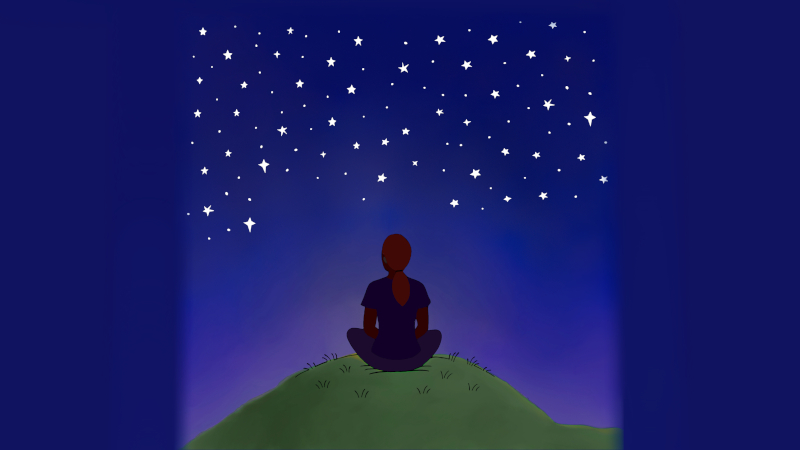
Featured image: Original artwork © 2026 by Sunny Simmons.
Leave a Reply