
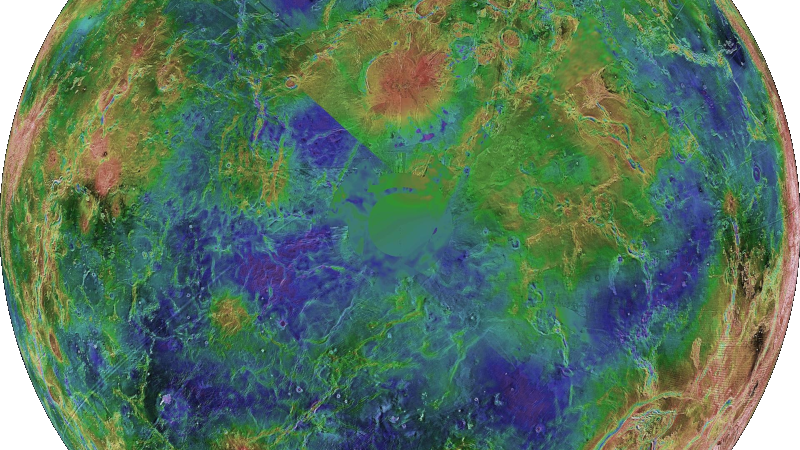
Venus is the second planet from the Sun and Earth’s closest planetary neightbor in size. Slightly smaller than our own world, Venus is often called Earth’s “sister planet” because the two planets have similar diameters, masses, and compositions.
Despite those similarities, Venus is one of the most hostile places in the solar system. Its thick atmosphere traps heat so effectively that surface temperatures are hot enough to melt lead, making Venus even hotter than Mercury despite being farther from the Sun.
For much of human history, Venus was one of the most important objects in the sky.
It is the brightest planet visible from Earth and is often the first “star” to appear after sunset or the last to disappear before sunrise. Ancient cultures around the world tracked its movements, incorporated it into calendars, and associated it with gods, goddesses, kings, warfare, fertility, and prophecy.
Because Venus remains relatively close to the Sun in our sky, it appears only as a Morning Star or Evening Star, enver high overhead at midnight. Its regular cycle of appearances and disappearances made it especially important to ancient astronomers, including the Maya, who kept remarkably detailed records of its motions.
Today, Venus helps astronomers understand planetary climates, atmospheric evolution, and what can happen when a greenhouse effect runs completely out of control.
Seeing Venus
Venus is usually easy to spot with the naked eye. Look for an exceptionally bright, steady object low in the western sky after sunset or low in the eastern sky before sunrise. Unlike stars, Venus does not noticeably “twinkle” under most conditions.
Through a telescope, Venus displays phases similar to those of the Moon, a discovery that helped support the heliocentric model of the solar system.
Quick Facts
- Planet Type: Terrestrial planet
- Position from the Sun: Second
- Average distance from the Sun: 67 million miles (108 km)
- Length of year: 225 Earth days
- Length of a day: 243 Earth days
- Moons: None
- Surface temperature:About 867°F (464°C)
Fun Fact
A day on Venus is longer than its year.
Venus rotates so slowly that it takes about 243 Earth days to spin once on its axis, while it completes an orbit around the Sun in only 225 Earth days.
Related Terms
- planet
- inferior planet
- Morning Star
- Evening Star
- conjunction
- ecliptic
- greenhouse effect
- Maya astronomy
Featured image: Sun image courtesy of NASA/SDO via the NASA Image and Video Library.
