

Mention the zodiac and most people immediately think of horoscopes. Perhaps you’re a Leo. Or a Pisces. Maybe you’ve been told you’re incompatible with a Gemini, destined to marry a Scorpio, or doomed to have a terrible week because Mercury is doing something dramatic.
But whatever your opinion of astrology, there’s something important worth knowing: the zodiac is real. Not necessarily in the way modern horoscopes describe it, but as an actual region of the sky.
Long before the zodiac became associated with personality traits and newspaper columns, it served as one of humanity’s most practical astronomical tools. Ancient skywatchers used it to track the movements of the Sun, Moon, and planets, measure the passage of time, and organize their observations of the heavens.
In other words, the zodiac began as astronomy.
A Road Through the Stars
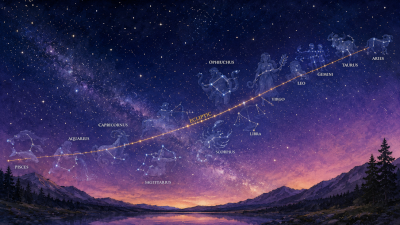
In a previous article, we explored the ecliptic: the apparent path the Sun follows across the celestial sphere over the course of a year. Because the planets orbit the Sun in nearly the same plane, they also appear to travel close to this path. The Moon spends most of its time nearby as well.
This creates a special band of sky surrounding the ecliptic. The constellations that occupy this celestial neighborhood form what we know as the zodiac.
Rather than being scattered randomly across the heavens, the zodiac constellations sit along the great highway traveled by the Sun, Moon, and planets. If the ecliptic is the road, the zodiac is the collection of landmarks along the way.
What Is a Constellation?
Before we go further, let’s talk about constellations. A constellation is simply a recognized region of the sky.
Many people imagine constellations as groups of stars connected into stick figures. While those familiar patterns are part of the story, modern astronomy treats constellations somewhat differently. Today, the sky is officially divided into 88 constellations. Every point in the heavens belongs to one of them.
Think of constellations as celestial countries drawn on an imaginary map. The stars themselves may be separated by vast distances. They only appear close together from our perspective on Earth.
The constellation boundaries, however, provide a useful way to identify locations in the sky. The zodiac constellations are simply the constellations through which the ecliptic passes.
The Traditional Zodiac
Most people are familiar with the twelve traditional zodiac signs:
- Aries
- Taurus
- Gemini
- Cancer
- Leo
- Virgo
- Libra
- Scorpio
- Sagittarius
- Capricorn
- Aquarius
- Pisces
These constellations form a rough ring around the sky and have been used for thousands of years to track celestial motion.
As the year progresses, the Sun appears to move through each of these constellations in turn. The Moon follows a similar path. The planets wander among them.
For ancient observers, the zodiac provided a convenient celestial calendar. If someone said Mars was in Taurus or the Moon was near Gemini, other skywatchers immediately knew where to look.
The Constellation Everyone Forgets
At this point, some readers may be thinking: “Wait a minute. Aren’t there actually thirteen zodiac constellations?”
Astronomically speaking, yes.
The ecliptic passes through a constellation called Ophiuchus, the Serpent Bearer. Located between Scorpius and Sagittarius, Ophiuchus occupies a portion of the ecliptic that the Sun traverses every year.
This means the Sun actually spends time in thirteen constellations, not twelve. So why isn’t Ophiuchus included in most zodiac systems? The answer is historical rather than astronomical.
Ancient astrologers divided the ecliptic into twelve equal sections because twelve fit neatly with existing calendars and seasonal cycles. The signs of astrology became symbolic divisions of the sky rather than precise representations of the actual constellation boundaries.
The twelve-sign zodiac remained. Ophiuchus got left out.
The stars, naturally, did not care.
Signs Are Not Constellations
This distinction is one of the most commonly misunderstood aspects of the zodiac. The zodiac signs used in most Western astrology are not the same thing as the zodiac constellations.
Constellations vary dramatically in size. Virgo occupies a large region of the sky. Scorpius is comparatively small. Ophiuchus sits right in the middle of the action.
The astrological zodiac, however, divides the ecliptic into twelve equal thirty-degree segments. Those segments are called signs.
Originally, the signs roughly corresponded to the constellations that shared their names. Over time, however, the two systems drifted apart.
The Slow Wobble of Earth
Part of the reason for this drift is a phenomenon called precession.
Earth does not spin perfectly upright like a toy top. Instead, its rotational axis slowly wobbles over time. One complete wobble takes about 26,000 years.
As Earth wobbles, the position of the equinoxes gradually shifts relative to the stars. Two thousand years ago, the Sun’s position during the spring equinox aligned more closely with the constellation Aries. Today, that same point lies in Pisces and is slowly moving toward Aquarius.
This means the modern astrological signs no longer line up perfectly with the constellations from which they originally took their names. The stars have moved only slightly. Our reference points have shifted.
Why Ancient Cultures Cared
The zodiac was one of humanity’s earliest celestial coordinate systems. It provided a framework for tracking the movements of the Sun, Moon, and planets. It helped organize calendars and seasonal observations. It aided navigation. It allowed astronomers separated by great distances and centuries of time to describe what they were seeing.
But the zodiac was never merely practical. Humans are storytellers.
The constellations became heroes, animals, monsters, rulers, hunters, and gods. Different cultures created different stories, but the same stars often served as the canvas.
Over time, astronomical observation and symbolic interpretation became deeply intertwined. The zodiac became both a map and a mythology.
A Real Place in an Imaginary Sky
The zodiac occupies a unique position in human history. It is simultaneously an astronomical reality and a cultural artifact.
The constellations are real regions of the sky. The ecliptic is a real feature of celestial mechanics. The planets genuinely travel through this celestial neighborhood.
What humans have chosen to believe, symbolize, predict, celebrate, or imagine about those movements is a separate story entirely.
Both stories matter.
One helps us understand how the heavens work. The other helps us understand how humans have interpreted them. And both begin with the same simple act:
Looking up.
Leave a Reply