

If you’ve ever watched the stars wheel overhead on a clear night, you’ve probably noticed something strange. Everuthing seems to be moving.
The Sun rises in the east and sets in the west. The Moon drifts across the sky. Constellations appear to rotate around the North Star. Even the planets wander slowly among the stars over time.
It certainly looks like the heavens are spinning around us.
Of course, we know better. Or at least, we think we do.
Most of us learn at a young age that Earth rotates on its axis once every twenty-four hours. The Sun isn’t actually circling us. Neither are the stars. We are the ones doing the moving.
So why do astronomers still talk about the sky as though it were wrapped around Earth? Because sometimes an illusion is useful.
Enter the celestial sphere.
A useful fiction
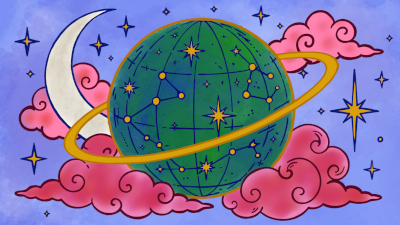
The celestial sphere is one of astronomy’s oldest and most useful ideas.
Imagine standing outside on a clear night. Now imagine that the entire sky is actually the inside surface of an enormous hollow sphere surrounding Earth. Every star, planet, and constellation appears painted on the inside of that sphere. You’re standing at the center.
That’s the celestial sphere.
Is it real? Not even a little. The stars are not attached to a giant dome. Some are relatively nearby neighbors within our galaxy, while others are hundreds or thousands of light-years farther away. The planets are much closer. The Moon is closer still. In reality, space is a vast three-dimensional expanse.
But from our perspective here on Earth, everything appears projected onto a single celestial backdrop. The celestial sphere gives us a convenient way to describe what we see without constantly worrying about actual distances.
Think of it as the astronomical equivalent of a map. A road map isn’t the landscape itself. It’s a simplified representation that helps us navigate. The celestial sphere serves the same purpose for the sky.
Why everything appears to move
If the celestial sphere were real, it would appear to rotate around us once every day. Of course, what’s actually happening is that Earth is spinning.
Our planet rotates eastward, completing one full turn roughly every twenty-four hours. Because of that rotation, the sky appears to move westward. This apparent movement is called diurnal motion, from the Latin word for “daily.”
It’s responsible for:
- Sunrise and sunset
- Moonrise and moonset
- The apparent movement of stars across the sky
- The nightly turning of the constellations
Imagine sitting on a merry-go-round. As you spin, the world around you appears to move in the opposite direction. The same thing happens on Earth. We’re riding a spinning planet, and the sky only seems to be doing the dancing.
The celestial poles
Now let’s stretch Earth’s geography into space.
If you could extend Earth’s axis outward beyond the North and South Poles, those imaginary lines would eventually intersect the celestial sphere. Those points are called the celestial poles.
For observers in the Northern Hemisphere, one star sits remarkably close to the north celestial pole: Polaris, commonly known as the North Star.
Polaris isn’t especially bright, nor is it particularly unusual. Its fame comes from its location.
Because it lies almost directly above Earth’s rotational axis, Polaris appears nearly stationary while the rest of the sky slowly circles around it.
If you’ve ever seen photographs of star trails forming concentric circles around a fixed point in the sky, you’ve seen the celestial pole in action. The stars aren’t actually orbiting Polaris. We’re simply watching Earth turn beneath them.
The celestial equator
Just as Earth’s poles can be projected into space, so can Earth’s equator. The result is the celestial equator, an imaginary line wrapped around the celestial sphere directly above Earth’s equator.
This celestial equator divides the sky into northern and southern halves. Astronomers use it as one of the primary reference lines for locating objects in the sky, much like geographers use Earth’s equator when describing locations on our planet.
Again, none of these lines actually exist. No giant glowing circle hangs in the heavens. But these invisible reference points allow astronomers to create a coordinate system for the sky that works remarkably well.
Your place changes everything
One of the most fascinating aspects of the celestial sphere is that everyone sees a slightly different version of it. Where you stand on Earth matters.
Someone standing near the equator can see portions of both the northern and southern skies. They have access to a vast celestial panorama.
Someone living much farther north sees a different view. Certain southern constellations never rise above the horizon at all.
Meanwhile, observers in the Southern Hemisphere enjoy constellations that many northerners will never see.
The sky isn’t changing. Your vantage point is. The celestial sphere reminds us that every observation begins somewhere. Every sky has a point of view.
Why astronomers still use it
At this point, you might reasonably ask why modern astronomers still bother with a model that isn’t physically real. The answer is simple. Because it works.
When we observe the sky from Earth, we’re interested in where things appear to be. The celestial sphere provides a practical framework for describing those positions. It’s the foundation of star charts, telescope alignment systems, celestial coordinates, and countless other tools astronomers rely on every day.
Sometimes the best way to understand something complex is not to model reality exactly, but to model what we actually experience. The celestial sphere does exactly that. It’s an imaginary object that doesn’t exist. And yet, for thousands of years, it has helped humanity make sense of the heavens.
Not bad for a giant invisible ball.
Looking ahead
Now that we have our celestial stage, we can begin examining some of the actors moving across it.
In the next article, we’ll explore one of the most important paths in the sky: the ecliptic, the invisible track traced by the Sun across the celestial sphere and the foundation of seasons, eclipses, the zodiac, and much of humanity’s oldest sky lore.
Featured image: Original artwork © 2026 by Sunny Simmons.
Leave a Reply