

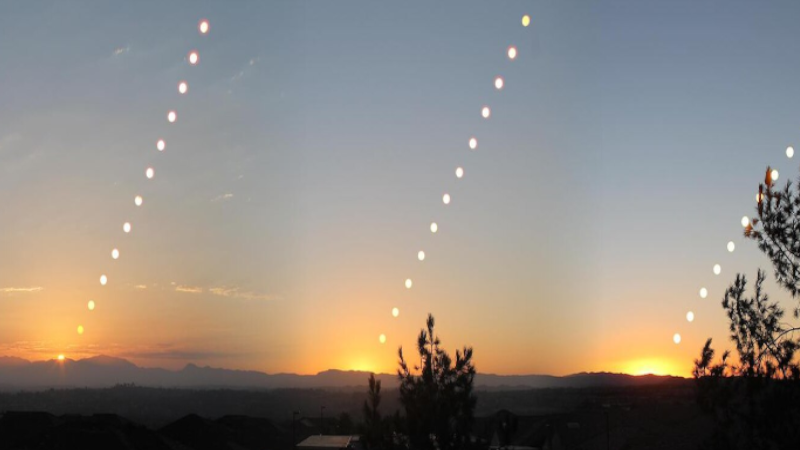
If you’ve ever watched where the Sun rises over the course of a year, you may have noticed something surprising. It doesn’t always come up in the same place.
Most of us grow up with the idea that the Sun rises in the east and sets in the west. That’s true in a general sense, but it’s only exactly true on two days each year. The rest of the time, the Sun is slowly wandering.
In summer, it rises north of east and sets north of west. In winter, it rises south of east and sets south of west. Day by day, week by week, the position shifts so gradually that most people never notice it.
Ancient peoples, however, absolutely noticed.
Long before clocks, calendars, weather forecasts, or smartphone reminders, the changing position of the Sun served as one of humanity’s most reliable indicators of the seasons. Knowing when to plant, harvest, travel, hunt, or prepare for winter could be a matter of survival.
The reason the Sun appears to wander across our horizon is the same reason we experience seasons in the first place: Earth’s axis is tilted.
As we discussed in our article on the ecliptic, Earth’s rotational axis is tilted about 23.5 degrees relative to its orbit around the Sun. Because of that tilt, the Sun appears to follow a path through the sky that is inclined relative to the celestial equator.
As the year progresses, the Sun slowly moves northward and southward against the background of the stars, tracing out an annual cycle that gives us the solstices and equinoxes.
The Equinoxes: Days of Balance
Twice each year, the Sun crosses the celestial equator. These moments are known as the equinoxes, a word derived from Latin meaning “equal night,” because on these dates, day and night are approximately equal in length all over the world.
The vernal, or spring, equinox occurs around March 20 or 21, when the Sun crosses from the southern half of the celestial sphere into the northern half. Roughly six months later, around September 22 or 23, the autumnal equinox occurs as the Sun makes the return journey southward.
The equinoxes are also the only times during the year when the Sun rises almost exactly due east and sets almost exactly due west. Every other day of the year, it rises and sets somewhere else.
If you were to mark the position of sunrise on the horizon every morning, you’d see it steadily drift northward after the spring equinox, reach its northernmost point in June, then begin moving southward again until December.
It’s a slow-motion celestial pendulum that has been keeping time for our species for thousands of years.
The Solstices: When the Sun Seems to Stand Still
Midway between the equinoxes, the Sun reaches the northernmost or southernmost point of its annual journey. These are the solstices, the word coming from the Latin solstitium, meaning “the Sun stands still.”
Of course, the Sun isn’t actually stopping. But if you carefully track its daily movement along the horizon, you’ll notice that its northward or southward progress slows dramatically near these turning points. For several days, its position changes very little before reversing direction.
To ancient observers, it genuinely appeared as though the Sun had paused.
The summer solstice occurs around June 20 or 21 in the Northern Hemisphere. On this day, the Sun reaches its greatest northern declination, about 23.5 degrees north of the celestial equator. It is also the longest day and shortest night of the year for those of us north of the Equator.
The winter solstice occurs around December 21 or 22, when the Sun reaches its southernmost point and we experience the shortest day and longest night of the year.
These four seasonal markers, two equinoxes and two solstices, divide the Earth’s annual journey around the Sun into quarters and form the backbone of many traditional calendars.
The Tropics, the Arctic, and Everything In Between
The Sun’s yearly north-south journey also defines some of the most important geographic regions on Earth.
Between 23.5° north and 23.5° south latitude lie the tropics. Somewhere within this region, the Sun can appear directly overhead at noon during part of the year.
The northern boundary is known as the Tropic of Cancer, while the southern boundary is the Tropic of Capricorn. These names come from the zodiac constellations in which the Sun appeared thousands of years ago when these lines were first defined.
Farther north and south are the Arctic and Antarctic Circles at approximately 66.5° latitude.
Beyond these boundaries, something remarkable happens. There are times of the year when the Sun never rises. And other times when it never sets. The closer you travel toward either pole, the more extreme these effects become, culminating in months of continuous daylight or darkness near the poles themselves.
The same 23.5-degree tilt that gives us pleasant spring afternoons and long summer evenings is also responsible for the midnight sun of the Arctic and the long polar night of winter.
Reading the Seasons
The changing position of the Sun has served as a calendar for humanity for thousands of years.
One of the most famous examples is Stonehenge in southern England. While its exact purpose remains a matter of debate, the monument appears to have been carefully aligned with the movements of the Sun. On the summer solstice, an observer standing within the circle sees the rising Sun appear in alignment with key stones and earthworks.
But Stonehenge is far from unique. Cultures around the world built monuments, temples, observatories, and ceremonial sites designed to mark the turning points of the year. The details varied, but the goal was often the same: to track the Sun’s annual journey and anticipate the changing seasons.
For people whose lives depended on agriculture, migration, trade, or ritual observance, these celestial milestones weren’t abstract astronomical concepts; they were practical tools. The sky was a calendar. And the Sun was one of its most important hands.
Featured image: “A composite panorama of three sunrises, showing the Sun’s path at the solstices and equinoxes” by John Krieger (CC BY 4.0).
Leave a Reply