

Imagine standing on the deck of a ship in the middle of the Atlantic Ocean. No landmarks. No GPS. No radio. Nothing but water in every direction and a sky full of stars overhead.
For most of human history, that wasn’t a thought experiment. It was reality.
If you wanted to know where you were, you had to figure it out yourself. Entire fortunes, military campaigns, trade routes, and human lives depended on it. A ship that missed its destination by a few degrees might arrive hundreds of miles from its intended port, or worse, wreck itself on unseen reefs and rocky coastlines.
The solution to this problem was one of humanity’s greatest navigational achievements: an invisible grid wrapped around the Earth known as latitude and longitude.
Today, we barely think about it. We tap an address into a phone, drop a pin on a map, and let satellites do the hard work. But behind that simple blue dot lies a fascinating story involving astronomy, mathematics, exploration, and one stubborn clockmaker who spent decades trying to solve a problem many experts thought was impossible.
Wrapping a grid around a globe
Because the Earth is roughly spherical, finding a precise location requires more than simply saying “go north” or “head west.” We need a way to describe any point on the planet using a consistent set of coordinates. Latitude and longitude provide exactly that.
Together, they form a global coordinate system that can identify virtually any location on Earth, from the summit of Mount Everest to your favorite neighborhood coffee shop.
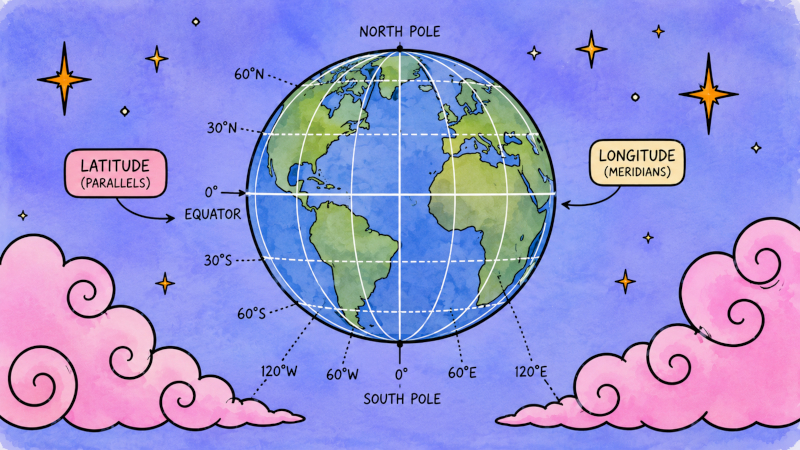
The system works by dividing the Earth with two sets of imaginary lines. One set runs east and west around the globe. The other runs north and south from pole to pole. Where those lines intersect, you have a unique address for a specific location.
Latitude: the easy one
Latitude measures how far north or south you are from the Equator.
If you’ve ever looked at a globe and noticed horizontal rings circling the planet, you’ve seen lines of latitude. Because these lines remain parallel to one another, they are often called parallels.
The Equator serves as the natural starting point and is assigned a latitude of 0°. From there, latitude increases as you travel north or south. The North Pole sits at 90° North latitude, while the South Pole lies at 90° South latitude. Everything north of the Equator belongs to the Northern Hemisphere. Everything south belongs to the Southern Hemisphere.
Several famous lines of latitude also divide the globe into important climate and daylight regions. The Tropic of Cancer lies at approximately 23.5° North, while the Tropic of Capricorn sits at roughly 23.5° South. Farther toward the poles are the Arctic and Antarctic Circles at approximately 66.5° North and South.
Unlike many human-made systems, latitude is based on a natural feature of the Earth itself. The Equator exists whether humans recognize it or not, making it an obvious reference point from which to measure.
Latitude also has a direct connection to the sky.
If you’ve been following our Reading the Sky series, you’ll remember that the celestial poles appear at different heights above the horizon depending on where you are on Earth. In fact, the altitude of the North Celestial Pole above your northern horizon is equal to your latitude.
At the North Pole, the celestial pole sits directly overhead. At the Equator, it rests on the horizon. Everywhere else falls somewhere in between.
This relationship made latitude surprisingly easy for navigators to determine. By measuring the height of Polaris above the horizon, sailors could estimate their north-south position with remarkable accuracy.
Longitude, unfortunately, was not nearly so cooperative.
Longitude: the difficult one
Longitude measures how far east or west you are.
The lines of longitude, called meridians, run from the geographic North Pole to the geographic South Pole. Unlike lines of latitude, all meridians eventually meet at the poles.
This creates an immediate problem.
The Earth has an obvious equator, but it doesn’t have an obvious starting meridian.
Nature gives us a north-south axis. It does not give us an east-west zero point.
Humans had to choose one.
Today, that reference line is known as the Prime Meridian. It passes through Greenwich, England, at the site of the historic Royal Observatory. By international agreement, this location was designated 0° longitude in the late nineteenth century.
From there, longitude is measured east and west up to 180°, where the two halves of the globe meet on the opposite side of the planet.
Once you know both your latitude and your longitude, you can identify your position anywhere on Earth with remarkable precision.
Reading coordinates
You may have seen coordinates written using degrees (°), minutes (′), and seconds (″).
This system traces its roots back thousands of years to ancient Babylonian mathematics, which divided circles into 360 degrees and counted using groups of sixty rather than ten.
A coordinate such as:
33° 51′ 30″ S, 151° 12′ 53″ E
means 33 degrees, 51 minutes, and 30 seconds south of the Equator, and 151 degrees, 12 minutes, and 53 seconds east of the Prime Meridian.
Today, you’re more likely to encounter decimal coordinates instead. Modern GPS systems and mapping software typically express locations as decimal degrees. For example, the Library of Congress in Washington, D.C. is located at approximately:
38.888611, -77.004722
In this format, positive numbers generally indicate north latitude and east longitude, while negative numbers indicate south latitude and west longitude.
But what does a degree actually represent?
A degree of latitude corresponds to roughly 111 kilometers (69 miles) anywhere on Earth. Longitude is a little trickier. At the Equator, a degree of longitude is also about 111 kilometers wide, but the meridians gradually converge as they approach the poles. By the time you reach either pole, the distance between lines of longitude shrinks to essentially zero.
Those numbers are useful on paper.
Actually determining your coordinates while standing on the deck of a rolling ship in the middle of the ocean was another matter entirely.
The longitude problem
For centuries, sailors could determine latitude with reasonable confidence. The sky practically handed them the answer.
In the Northern Hemisphere, the altitude of Polaris above the horizon closely matches your latitude. If Polaris appeared 40 degrees above the northern horizon, you were at roughly 40° north latitude. Even when Polaris wasn’t visible, navigators could use the Sun and stars to estimate their position.
Longitude was a different beast altogether. A captain might know exactly how far north or south he was and still have no reliable way to determine how far east or west he had traveled. The consequences could be catastrophic.
A ship crossing the Atlantic might miss its destination by hundreds of miles. Fleets could become separated. Merchant vessels could sail directly into dangerous shoals or reefs. Entire voyages could be ruined because nobody knew their exact east-west position.
The challenge became so important that it was eventually known simply as The Longitude Problem. Solving it would require a breakthrough in both astronomy and timekeeping.
Why longitude is really a time problem
The key insight is surprisingly simple. The Earth rotates 360 degrees in 24 hours. That means it turns:
- 15 degrees every hour
- 1 degree every 4 minutes
If you know the local time where you are and the time at a known reference location, you can calculate your longitude.
Imagine it’s noon on your ship because the Sun has reached its highest point in the sky. If a clock set to Greenwich time reads 2:00 PM, then Greenwich is two hours ahead of you. Two hours multiplied by 15 degrees per hour equals 30 degrees. You are therefore approximately 30 degrees west of Greenwich.
Simple. At least in theory. The problem was that nobody could build a clock capable of keeping accurate time during a months-long sea voyage.
The clock worth a fortune
In the early eighteenth century, the longitude problem had become so severe that the British government decided to put a price on the solution. A very large price.
In 1714, during the reign of Queen Anne, Parliament passed the Longitude Act, offering rewards of up to £20,000 to anyone who could develop a practical method for determining longitude at sea. Adjusted for modern values, the prize was worth several million dollars.
The challenge wasn’t understanding what was needed. By this point, many scientists already recognized that accurate timekeeping held the key. More than half a century earlier, the Dutch astronomer, mathematician, and inventor Christiaan Huygens had dramatically improved the accuracy of clocks with his invention of the pendulum clock. He was among the first to recognize that precise timekeeping could provide a solution to the longitude problem, and he later developed the balance spring that would become a crucial component of portable timepieces.
Unfortunately, pendulum clocks proved too sensitive to the constant motion of a ship. The real challenge was not identifying the solution in theory, but building a clock that could keep accurate time through months of rolling seas, changing temperatures, salt air, and storms.
Many of Europe’s greatest scientists believed astronomy would ultimately provide the answer. The man who finally solved the problem, however, wasn’t an astronomer. He was a carpenter.
John Harrison and the impossible clock
John Harrison had no university education and no aristocratic connections. He was a self-taught clockmaker from rural England. Where others searched the skies for a solution, Harrison focused on the clock.
The best timekeepers of the era were pendulum clocks. They worked wonderfully in homes and observatories. They were terrible aboard ships.
A rolling vessel constantly disrupted the pendulum’s swing. Changes in temperature caused components to expand and contract. Salt air corroded metal parts. Vibrations introduced errors.
Even tiny inaccuracies accumulated over weeks and months. And a small error in time translated into a large error in longitude.
Harrison became obsessed with solving the problem. His first design, known as H1, looked less like a clock and more like a piece of scientific machinery. Instead of a pendulum, it used interconnected balancing mechanisms designed to counteract the ship’s motion. The entire device was mounted in gimbals so it could remain relatively level even when the vessel pitched and rolled.
It worked. But Harrison wasn’t satisfied. Over the next three decades, he continued refining and improving his designs. Each version came closer, and finally, in 1759, Harrison completed H4.
Unlike his earlier machines, H4 resembled an oversized pocket watch. It was compact. Durable. Astonishingly accurate. Most importantly, it could keep time during long sea voyages. For the first time in history, navigators could carry a reliable reference clock across the ocean.
The longitude problem was effectively solved. After centuries of uncertainty, sailors finally had a dependable way to determine their east-west position anywhere on Earth. The oceans suddenly became a much smaller place.
Time zones and traveling to yesterday
The connection between longitude and time didn’t disappear once sailors learned how to navigate the oceans. In fact, it’s still baked into the way we organize our clocks today.
The word meridian comes from Latin roots meaning “middle” and “day,” referring to the moment when the Sun reaches its highest point in the sky: noon. The familiar abbreviations a.m. and p.m. come from the Latin phrases ante meridiem (“before midday”) and post meridiem (“after midday”).
For most of human history, every town simply set its clocks according to the Sun. When the Sun reached its highest point overhead, it was noon. Simple. The problem was that noon doesn’t happen everywhere at the same time.
A town located a few miles west of another town experiences local noon a few minutes later. Before fast transportation and long-distance communication, this wasn’t much of an issue. People rarely traveled far enough or fast enough to notice. Then came the railroads.
By the middle of the nineteenth century, trains were crisscrossing countries at speeds never before possible. Every city maintained its own local time, creating a scheduling nightmare. Travelers had to constantly adjust their watches, railroad timetables became increasingly complicated, and telegraph operators struggled to coordinate communications between distant locations.
Something had to change. The solution? Divide the Earth into broad regions that would all share the same standard time.
Because the Earth rotates 360 degrees in 24 hours, it turns approximately 15 degrees every hour. That makes 15 degrees of longitude a convenient unit for a time zone.
In practice, political borders, geography, and human stubbornness have produced plenty of exceptions, but the underlying principle remains the same. As you travel east or west around the globe, local time changes because longitude and the Earth’s rotation are fundamentally linked.
This raises an interesting question. What happens if you keep traveling?
Imagine heading west around the Earth, adjusting your watch backward hour by hour as you cross each time zone. Eventually, you’ve gone all the way around the planet. Your clock says one thing. Your calendar says another. And suddenly you’ve stumbled into a paradox.
If every hour traveled west takes you further back in local time, then completing a full circuit of the globe would seem to put you a full day behind everyone who stayed home.
Clearly, something has to give. The solution is the International Date Line.
Located roughly along the 180th meridian in the Pacific Ocean, the International Date Line serves as the place where the calendar resets itself. It zigzags around island groups and political boundaries, but its purpose is straightforward: to keep the world’s dates synchronized.
Cross it traveling west, and the calendar advances by one day. Cross it traveling east, and the calendar moves back by one day. You aren’t actually traveling through time, of course. But it’s probably the closest most of us will ever come.
Beyond the Earth
Although latitude and longitude were developed to describe locations on Earth, astronomers eventually adapted similar ideas for mapping the sky itself.
After all, if you can create a coordinate system for a planet, why not create one for the celestial sphere?
Instead of latitude, astronomers use a coordinate called declination. Like latitude, declination measures angular distance north or south, but instead of using the Earth’s equator, it uses the celestial equator projected onto the sky.
Instead of longitude, astronomers use right ascension, which measures positions eastward around the celestial sphere.
Unlike terrestrial longitude, right ascension is usually expressed in hours, minutes, and seconds of time rather than degrees. This might seem strange until you remember that the sky itself appears to rotate because of the Earth’s rotation. Since the Earth turns 15 degrees every hour, expressing celestial coordinates in units of time becomes remarkably convenient.
Together, right ascension and declination allow astronomers to pinpoint stars, galaxies, nebulae, planets, and countless other celestial objects with extraordinary precision.
If you’ve ever used a computerized telescope, looked up the coordinates of a deep-sky object, or followed a star chart, you’ve already encountered the celestial descendants of latitude and longitude.
A grid worth remembering
Latitude and longitude are often taught as geography. Their history, however, is deeply tied to astronomy.
Navigators measured the height of stars above the horizon to determine latitude. Astronomers mapped the heavens to aid exploration. Clockmakers built astonishingly precise instruments so sailors could compare one meridian to another. Together, they solved one of the greatest scientific and technological challenges of the age.
In a very real sense, humanity learned to navigate the Earth by learning to read the sky.
Today, your phone can determine your position within a few feet almost instantly. Satellites, atomic clocks, and computers handle calculations that once required years of study and some of the finest instruments ever built. Yet every time you check a map, search for an address, or glance at a GPS screen, you’re still relying on the same invisible framework that guided explorers across unknown oceans centuries ago.
Not bad for a few imaginary lines wrapped around a spinning sphere.
Leave a Reply